

Make the Most of Your Trip
Compare the top tours, passes, and experiences — find what fits your travel style.
Short Excerpt
- You can reduce jet lag before departure by gradually moving your wake time, bedtime, light exposure, meals, and caffeine toward the schedule your destination will require.
- A three-day shift of roughly 30–60 minutes per day can narrow the time-zone gap without forcing an abrupt sleep change the night before travel.
- Eastbound trips generally require an earlier schedule, while westbound trips usually require a later one, with arrival time and sleep sensitivity determining how aggressively you should adjust.
Quick Take
- Shift bedtime and wake time together for three days before departure instead of changing only when you go to bed.
- Move by roughly 30–60 minutes per day, using smaller changes when aggressive adjustments interfere with sleep.
- For eastbound travel, begin moving sleep and wake times earlier; for westbound travel, gradually move them later.
- Coordinate light exposure with the direction of the shift because light is one of the strongest signals controlling your circadian clock.
- Move meals and caffeine with the new schedule so they reinforce the change rather than pulling you back toward your normal routine.
- Protect the final night before departure because starting a long travel day already sleep-deprived can erase much of the advantage you created.
Start Beating Jet Lag Three Days Before You Board The Plane
Jet lag does not begin when you land.
The problem starts because your destination’s clock changes instantly while your circadian rhythm is still following the sleep, light, meal, and activity schedule you had at home.
That gives you an opportunity before the trip even starts. Instead of asking your body to absorb the entire time change after arrival, you can begin narrowing the gap during the three days leading up to departure.
The most practical approach is a gradual sleep shift.
Move your bedtime and wake time by roughly 30–60 minutes each day, keeping both ends of the sleep schedule moving together rather than forcing yourself into an unusually early or late bedtime while waking at the same old time.
Direction determines which way you move.
Eastbound travel usually requires an earlier body clock, so begin waking and going to bed earlier. Westbound travel generally requires the opposite, with wake time and bedtime moving later.
Arrival time matters too.
A morning arrival means you need enough alertness to function through much of the destination’s daytime, while an evening arrival makes protecting that first local bedtime especially important.
Red-eye flights complicate the picture further because cabin sleep rarely replaces a complete night in bed.
Light is one of the strongest tools supporting the shift.
When moving your schedule earlier, appropriately timed earlier-day light and a dimmer evening can help reinforce the change.
When shifting later, brighter light later in your day can support the delay, while large time-zone jumps may require more precise light timing than a simple morning-versus-evening rule.
Meals and caffeine should move with the schedule instead of remaining fixed to your old routine. Eat breakfast after your shifted wake time, move dinner in the same direction as bedtime, and keep caffeine far enough from your planned sleep period that it does not undermine the adjustment.
Do not try to manufacture a perfect six-hour time-zone change in three days.
Even moving your internal schedule one or two hours closer to destination time can reduce the mismatch you have to handle after landing.
The final night before travel deserves protection.
Finish packing and logistics early, keep the last part of the evening low-stimulation, and avoid sacrificing sleep because you are trying to squeeze one more task into the night before departure.
Think of the process as a staircase rather than a cliff.
Small, repeatable changes before departure are much easier for your body to follow than attempting to force a completely different sleep schedule once you are already exhausted and far from home.
Plan Your Sleep Shift With A Clear Decision Tree
A sleep shift works best when it matches the trip you are actually taking.
Direction, arrival time, and sleep sensitivity shape what will help and what will backfire.
Light exposure timing is the strongest lever, so the decision tree is built around it.
Use this section once, then follow the plan without second-guessing.
The goal is fewer variables, not more.
Clarity is what makes follow-through realistic.
Decide Your Shift Direction
Destinations ahead of your home time create an eastbound-style problem, even on indirect routes.
Eastbound travel usually requires advancing your body clock, which means earlier sleep and earlier wake.
Destinations behind your home time create a westbound-style problem.
Westbound travel usually requires delaying your body clock, which means later sleep and later wake.
Trips within one time zone still benefit from small shifts, especially for early arrivals.
Larger time-zone jumps benefit more, but even a one- to two-hour shift makes the first day feel less harsh.
Decide What Kind Of Arrival You Have
Morning arrivals demand a plan that keeps you functional through the first daylight stretch.
Midday arrivals allow a gentler approach because the day is already underway.
Evening arrivals put emphasis on protecting the first destination night as your anchor.
Red-eye arrivals often require a “rest, not perfection” mindset because cabin sleep is rarely a full night.
Connections increase sleep fragmentation and stress, so more buffer becomes part of the sleep strategy.
Family travel adds another factor, which is overstimulation and routine disruption for kids.
Decide Your Sensitivity Pace
Sleep-sensitive travelers do better with smaller daily steps and stricter evening dimming.
Heavy sleepers can usually handle slightly bigger steps without losing sleep quality.
Anxious travelers benefit from more structure because uncertainty keeps the nervous system alert.
Business travelers benefit from a lighter first day because performance drops when sleep debt stacks.
Older adults often notice caffeine lingering longer, which makes timing decisions more important.
Frequent flyers do best with repeatable rules that prevent wild swings between trips.
Quick Picks That Prevent Overthinking
Eastbound with a morning arrival works best with an earlier shift and strong morning light after landing.
Westbound with a morning arrival works best with a later shift and controlled morning light on day one.
Eastbound with an evening arrival works best with an earlier shift and a protected first destination night.
Westbound with an evening arrival works best with a later shift and minimal napping.
Uncertainty about direction is common on multi-leg routes, so a one-hour pre-shift plus strict light timing after landing is a safe default.
A plan that feels simple is more likely to be executed while tired.
Direction Drives Rhythm
Shifting the wrong way is the fastest route to stronger jet lag.
Arrival Sets Priorities
Landing time determines whether morning light, evening dimming, or the first night matters most.
Pace Protects Sleep
Smaller steps often outperform aggressive changes for sleep-sensitive travelers.
Your 3-Day Adjustment Plan With Two Versions
This is the core system.
You will choose the “shift earlier” or “shift later” version based on your destination.
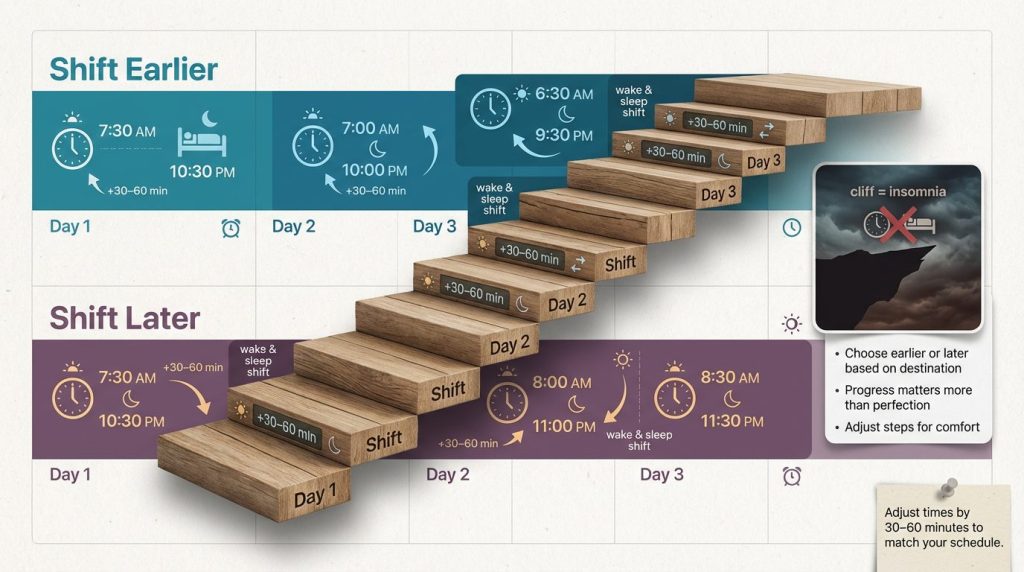
Each day changes wake time and bedtime together, because that is what creates real movement.
The shift range is 30 to 60 minutes per day for most travelers.
A larger shift is possible, but comfort and sleep quality usually drop when the steps get too big.
Progress matters more than perfection, and partial shifts still pay off.
Define Your Target Sleep Window First
Start with the day you land.
Picture the first three hours after arrival and ask when you need to be alert.
That time becomes the anchor for your destination wake time.
A realistic bedtime follows from that wake time, usually allowing seven to nine hours of sleep opportunity.
That planned block is your sleep window, which means sleep is allowed inside it and discouraged outside it.
A clear sleep window reduces late-night bargaining and reduces the urge to improvise.
Version A: Shift Earlier For Eastbound Trips Or Early Arrivals
Day 3 begins the staircase.
Wake 30 to 60 minutes earlier than normal and seek bright light within the first hour.
Move bedtime earlier by the same amount and keep the last hour dim and quiet.
Day 2 repeats the same move with the same pairing of earlier wake and earlier bed.
Day 1 locks the new timing in and protects sleep quality, because the night before travel is where sleep debt usually starts.
Packing earlier and ending logistics earlier helps because midnight planning keeps the nervous system alert.
A smaller caffeine window earlier in the day helps prevent bedtime delay.
Version B: Shift Later For Westbound Trips Or Late-Night Destination Timing
Day 3 starts by moving wake time later by 30 to 60 minutes.
Delay strong bright light slightly in the first hour and seek brighter light later in the afternoon.
Bedtime shifts later by the same amount while the last hour remains dim to protect sleep quality.
Day 2 repeats the shift and avoids long naps that steal nighttime sleep drive.
Day 1 keeps the later timing consistent and minimizes early morning bright light that would pull the clock earlier.
A later caffeine window can be tolerated by some travelers, but the last several hours before bed should remain low-caffeine when sleep sensitivity is high.
Meals shift later alongside sleep timing to reinforce the new rhythm.
Shift Both Ends
Wake time and bedtime must move together for the plan to work reliably.
Keep Steps Manageable
Thirty to sixty minutes per day is a sweet spot for many travelers.
Protect The Final Night
The night before travel often decides whether the trip starts with sleep debt.
Light Management That Makes The Shift Stick
Light exposure timing is the strongest cue your body uses to set circadian rhythm.
Morning light tends to move your clock earlier, while evening light tends to move your clock later.
That principle is simple, but execution matters.
A bright first hour after waking can help, and a dim last hour before bed helps even more than people expect.
Screens are the most common source of wrong-time bright light.
Night mode and reduced brightness are not aesthetic choices here.
They are clock management.
Light Rules For Shifting Earlier
Bright light soon after waking is the priority.
Outdoor light is the most powerful cue, even on cloudy days.
Indoor bright light near a window can still help when outdoor exposure is limited.
Evenings should dim earlier than usual, especially in the last hour before bedtime.
This supports melatonin signaling by reducing melatonin suppression from bright light.
Screens should be dimmed aggressively, and long scrolling sessions should end earlier than you think.
Light Rules For Shifting Later
Strong bright light immediately after waking can pull the clock earlier, so moderation helps.
Brighter light later in the afternoon and early evening supports delaying your schedule.
A dim last hour still matters because sleep quality is more valuable than staying up an extra 15 minutes.
Screens should be reduced in brightness near bedtime to prevent sleep onset struggles.
A consistent routine matters more than perfect timing.
Your brain responds to patterns, not heroic one-off efforts.
One Rule That Works For Most People
Make the first hour after waking align with the direction you want your clock to move.
Make the last hour before bed dim and boring.
That combination creates the strongest boundary cues your nervous system can recognize.
A bright morning plus a dim evening produces a stable rhythm for most travelers.
A dim morning plus a bright evening produces drift and confusion.
Sleep shifts succeed when boundaries are obvious.
Light Sets The Clock
Consistent light timing drives faster adjustment than most other tools.
Screens Are The Hidden Variable
Phone brightness late at night often delays sleep without you noticing.
Boundaries Create Rhythm
A bright start and a dim finish helps the body follow the new schedule.
Meal Timing And Hydration Anchors
Meals are secondary cues that still matter.
Breakfast timing tells your body “the day starts now.”
Dinner timing tells your body “night is approaching.”
Random eating sends mixed signals and slows adjustment.
A simple three-day meal pattern reinforces your shift and reduces travel-day stomach surprises.
Hydration supports energy and reduces headaches that can make jet lag feel worse.
Meal Timing Pattern For Three Days
Eat breakfast within a reasonable window after waking.
Keep lunch around the middle of your day.
Shift dinner earlier when shifting earlier, and later when shifting later.
Avoid heavy late meals because reflux and discomfort increase wakeups.
Light evening meals tend to protect sleep quality.
Consistent meal timing helps the clock lock in faster.
Caffeine And Hydration Rules That Avoid Regret
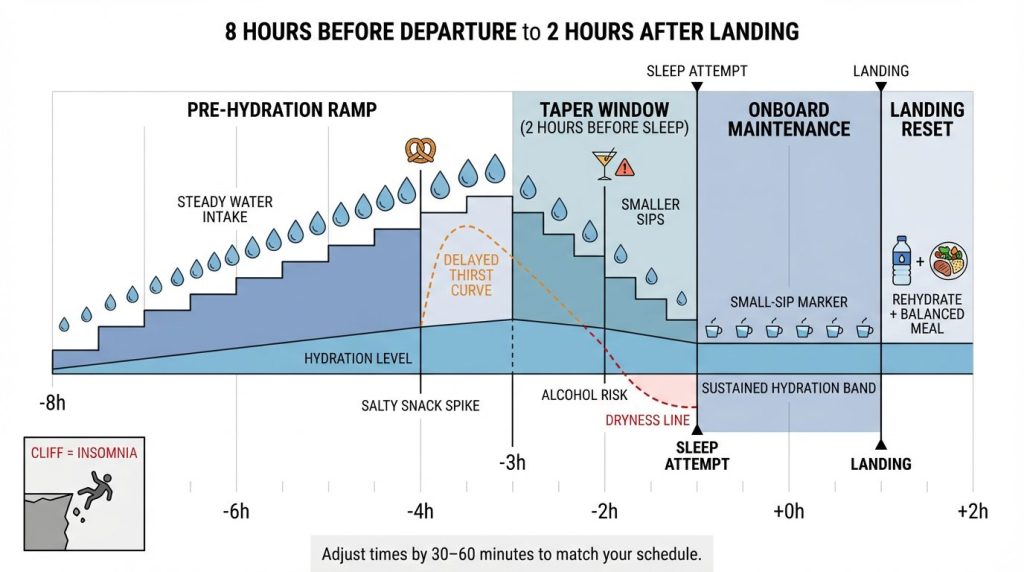
Hydrate steadily earlier in the day and taper near bedtime to reduce repeated restroom wakeups.
Caffeine should move with your schedule rather than fighting it.
Earlier shifts require earlier caffeine, because late caffeine often delays bedtime.
Later shifts allow caffeine to drift later for some people, but a protected low-caffeine window before sleep still helps sleep-sensitive travelers.
Caffeine half-life means caffeine can linger even when the buzz feels gone.
That lingering effect is the reason timing matters more than intention.
Meals Mark Time
Breakfast and dinner timing reinforce the schedule change.
Hydration Supports Stability
Headaches and dryness make shifting harder than it needs to be.
Caffeine Must Match The Goal
A caffeine window that fights your bedtime is a predictable failure point.
Protect Your Sleep Shift With Simple Travel-Day Rules
Travel day often destroys a good plan through chaos.
Airports are bright, schedules are uncertain, and people default to screens and snacks.
A simple protocol keeps the plan intact even when the day is messy.
This section is designed to be followed while tired.
A tired brain needs fewer choices.
A tired brain benefits from rules.
Morning Of Travel Day
Follow your shifted wake time as closely as possible.
Get light exposure consistent with your direction.
Eat breakfast at the usual post-wake time to anchor rhythm.
Hydrate earlier rather than chugging late.
Keep caffeine inside your planned window.
Packing and logistics should be finished early enough that bedtime does not become a last-minute problem.
During The Airport And Boarding Window
Use bright light as an alertness tool during the operational parts of travel.
Reduce screen brightness as soon as you shift into “rest mode.”
Avoid heavy meals close to your sleep attempt.
Choose a simple snack plan instead of constant grazing.
Organize essentials so you do not rummage repeatedly in the seat.
A reliable carry-on layout, like what many travelers like about Travelpro bags, reduces the chaos that wakes you fully.
On The Plane For A Red-Eye Sleep Attempt
Treat cabin sleep as a partial win, not a performance test.
Protect darkness with an eye mask and reduce screen use.
Mask variable noise with a consistent sound barrier.
Support your neck and lower back to reduce micro-adjustments.
Hydration should be steady earlier and lighter closer to sleep to reduce wakeups.
A structured routine signals safety to the nervous system, which improves your odds more than willpower does.
Rules Beat Willpower
Simple travel-day rules prevent chaos from undoing the shift.
Protect Rest Mode
Bright airport cues should not follow you into the sleep attempt.
Organization Reduces Wakeups
Fewer disruptions means longer sleep blocks and easier recovery.
Post-Landing Protocol That Speeds Adaptation
The first day after landing is where jet lag is either shortened or extended.
Light exposure timing is the steering wheel here.
A controlled nap strategy can help or harm depending on duration and timing.
Meals should be taken on destination time as soon as practical.
Movement helps reset mood and alertness.
The goal is a stable first destination night, because that night anchors your new rhythm.
Post-Landing Rules For Eastbound Travel
Seek morning light at the destination, especially in the first few hours after arrival.
Keep the first morning simple and low-stakes so fatigue does not become stress.
A short controlled nap can help if necessary, but long naps often steal the first night.
Avoid bright light late in the destination evening, because it delays adaptation.
Eat meals on destination time even when appetite feels odd.
Protect the first destination bedtime like it is the main treatment.
Post-Landing Rules For Westbound Travel
Moderate early morning bright light when it makes you wake too early.
Seek more light later in the day to support a delayed shift.
Avoid long naps that push bedtime late and create a second-night problem.
Eat meals on destination time and keep dinner consistent.
Movement and outdoor time in the afternoon helps alertness without relying on caffeine.
A stable destination bedtime is still the anchor even when you are shifting later.
First Night Anchors You
A stable destination bedtime accelerates adaptation more than most hacks.
Light Steers The Clock
Morning and evening light timing should match eastbound or westbound needs.
Naps Need Control
Short naps can support function, while long naps often extend jet lag.
Fix Jet Lag Problems Fast with Targeted Sleep Adjustments
Even good plans run into real life.
The goal is not to avoid every problem.
The goal is to know what to do when the predictable problems appear.
Use the troubleshooting steps below as targeted adjustments.
Small corrections usually work better than big resets.
A calm fix beats an aggressive restart.
Problem: You Shifted Bedtime Earlier But Cannot Fall Asleep
Sleep pressure may be too low because wake time did not shift enough.
Move wake time earlier the next day rather than forcing bedtime harder.
Dim light earlier in the evening and reduce screens more than you think is necessary.
Keep the last hour boring, because stimulation delays sleep onset.
Avoid compensating with a long nap because it will reduce sleep drive again.
Treat the first night as practice, not proof you failed.
Problem: You Wake Too Early And Cannot Get Back To Sleep
This often happens during an earlier shift or after an eastbound arrival.
Keep lights dim and avoid checking the phone, because bright light locks in the early wake.
Stay in a restful posture and allow quiet rest even without sleep.
A slightly later bedtime the next night can reduce early waking without undoing the shift.
Morning light should still occur at the planned time so your clock remains stable.
A controlled nap later can help if it does not steal bedtime.
Problem: You Needed A Nap And Now Bedtime Feels Impossible
The nap was likely too long or too late.
Keep the next nap shorter and earlier.
Use light and movement in the late afternoon to raise alertness naturally.
Eat dinner on schedule and dim lights on schedule even when you do not feel sleepy yet.
Avoid adding late caffeine to “fix” the nap mistake because it often creates another sleep delay.
The goal is restoring the anchor night, not chasing a perfect day.
Problem: Travel Logistics Kept Your Brain Alert At Night
Uncertainty triggers vigilance, which blocks sleep.
Close the loop early by saving confirmations and deciding transportation.
A secure, simple digital plan reduces stress, especially on public Wi-Fi, and NordVPN can help protect those connections when you are making tired decisions.
Travel disruption planning also reduces mental load.
Travel insurance from VisitorsCoverage, World Nomads, EKTA, or Insubuy can reduce financial worry around delays and interruptions depending on plan details.
When compensation pathways apply after disruptions, AirHelp and Compensair can help you navigate the process without improvising at 2:00 AM.
Fix One Variable
Small targeted changes usually outperform dramatic resets.
Protect The Anchor Night
Most recovery comes from restoring a stable bedtime at the destination.
Reduce Uncertainty
A closed-loop plan lowers vigilance and makes sleep more likely.
Visual Aid: A Sleep-Shift Schedule You Can Copy
This visual is meant to be simple enough to drop into your notes app.
Adjust the times by 30 to 60 minutes based on your own schedule.
The staircase shape is the point.
A staircase is sustainable.
A cliff creates insomnia.
Here are two examples you can customize.
3-Day Example for Shifting Earlier
Day 3: Bed 10:30 PM, Wake 6:30 AM, Bright light within one hour, Dinner slightly earlier.
Day 2: Bed 10:00 PM, Wake 6:00 AM, Bright light within one hour, Screens dim after 9:00 PM.
Day 1: Bed 9:30 PM, Wake 5:30 AM, Bright light within one hour, Light dinner, Quiet last hour.
3-Day Example For Shifting Later
Day 3: Bed 11:30 PM, Wake 7:30 AM, Brighter light later afternoon, Morning light moderate.
Day 2: Bed 12:00 AM, Wake 8:00 AM, Brighter light later afternoon, Avoid heavy late meals.
Day 1: Bed 12:30 AM, Wake 8:30 AM, Brighter light later afternoon, Dim last hour before bed.
How To Customize For Bigger Shifts
A two-hour change can be approached with 40 minutes per day over three days.
A three-hour change often needs 60 minutes per day plus post-landing light management.
A six-hour change will not be fully solved in three days, so the goal becomes reducing shock and protecting the first destination night.
Work constraints often limit wake-time changes, so partial shifts plus strict light timing still help.
Partial shifts still reduce symptoms because the gap is smaller.
Your body rewards momentum even when the shift is incomplete.
Staircases Beat Cliffs
Small daily steps are more likely to produce sleep than last-minute forcing.
Examples Remove Guessing
Seeing times written out makes the plan easier to execute.
Partial Progress Pays Off
A one-hour shift can meaningfully reduce early arrival misery.
Arrive Prepared And Feel More Predictable Faster
A sleep schedule adjustment works when it gives your body consistent cues it naturally follows.
Three days of gradual shifting, light timing, and meal anchors reduces jet lag and makes early arrivals more manageable.
Travel-day rules protect your progress when schedules get messy.
Post-landing light strategy shortens the adaptation window.
Troubleshooting prevents small failures from becoming full resets.
That is how preparedness becomes comfort before you even board.
FAQ – How Can You Start Beating Jet Lag Before Your Flight Even Leaves?
How Far in Advance Should You Start Adjusting for Jet Lag?
Three days gives many travelers enough time to make a meaningful partial adjustment without reorganizing an entire week around the trip.
Shift bedtime and wake time by roughly 30–60 minutes per day rather than trying to make the complete time-zone change at once.
Even a one- or two-hour head start can reduce the mismatch you face after landing.
Larger time changes will still require adjustment at the destination, so think of the pre-trip plan as reducing jet lag rather than eliminating it completely.Should You Shift Your Sleep Earlier or Later Before Traveling?
Use the destination’s time relative to home as your starting point.
Eastbound trips generally require moving your body clock earlier, which means gradually advancing bedtime and wake time.
Westbound travel usually requires a later schedule, so both should move in that direction.
Multi-leg itineraries can make the calculation less obvious, but the destination where you need to function is the schedule that ultimately matters.Why Should Bedtime and Wake Time Move Together?
Changing only bedtime can leave you lying awake because your body has not built enough sleep pressure at the new hour.
Moving wake time as well gives the entire sleep period a chance to shift rather than simply extending or shortening the night.
That makes the adjustment more consistent from one day to the next.
A gradual paired shift is generally easier to sustain than forcing an early bedtime while continuing to sleep late.How Much Should You Change Your Sleep Schedule Each Day?
Roughly 30–60 minutes per day is a practical range for many travelers.
Sleep-sensitive travelers may do better with smaller steps because an aggressive change can create difficulty falling asleep or waking when planned.
Someone who adjusts easily may tolerate the larger end of the range.
Consistency matters more than forcing the maximum possible change every night.How Does Light Help You Shift Your Body Clock Before Travel?
Light is one of the strongest signals your brain uses to determine biological time.
When you need to shift earlier, appropriately timed light earlier in your waking day and reduced bright light before the new bedtime can support that movement.
Shifting later generally calls for more light later in the day while avoiding cues that pull your schedule earlier.
Large time-zone changes can make ideal light timing more complicated, so a personalized jet-lag schedule can be useful when the shift is substantial.Should You Change Your Meal Times Before the Trip Too?
Yes, moving meals with your sleep schedule can provide another consistent time cue.
Eat breakfast after the new wake time, keep lunch near the middle of your shifted day, and move dinner earlier or later depending on the direction you are adjusting.
There is no need to force yourself to eat a large meal when you are not hungry.
The purpose is to make sleep, light, food, and activity increasingly point toward the same schedule.How Should You Adjust Caffeine During the Three-Day Jet Lag Plan?
Move caffeine in the same direction as the rest of your schedule while protecting the hours before sleep.
An eastbound adjustment usually means bringing your caffeine window earlier so it does not interfere with an earlier bedtime.
Westbound travelers may tolerate caffeine somewhat later when they are intentionally extending the day.
Whatever the direction, avoid using late caffeine to rescue a poorly timed nap or compensate for staying up too late.What Should You Do the Night Before a Long Flight?
Protect sleep instead of allowing last-minute travel preparation to consume it.
Finish packing, save confirmations, arrange transportation, and handle other logistics early enough that you are not solving problems in bed.
Keep the final hour relatively dim and low-stimulation, particularly when you have already shifted bedtime earlier.
Beginning the trip with unnecessary sleep debt makes both the flight and the destination adjustment harder.What If You Cannot Fully Adjust Before Departure?
Partial progress is still useful.
A six-hour difference is unlikely to disappear through three days of gradual changes, but moving even one or two hours closer reduces the remaining circadian gap.
Continue the adjustment after landing with appropriately timed light, destination-time meals, controlled naps, and a stable first-night bedtime.
Do not abandon the entire strategy simply because work or family obligations prevented a perfect pre-trip schedule.What Is the Simplest Three-Day Plan for Reducing Jet Lag Before Travel?
Choose the direction you need to move, then shift bedtime and wake time together by roughly 30–60 minutes each day.
Move light exposure, meals, and caffeine in the same direction while protecting the final night’s sleep.
On travel day, continue following the adjusted schedule as closely as the itinerary allows instead of immediately reverting to your old routine.
The goal is to board the flight with your body clock already moving toward the destination rather than asking it to make the entire adjustment after you land.