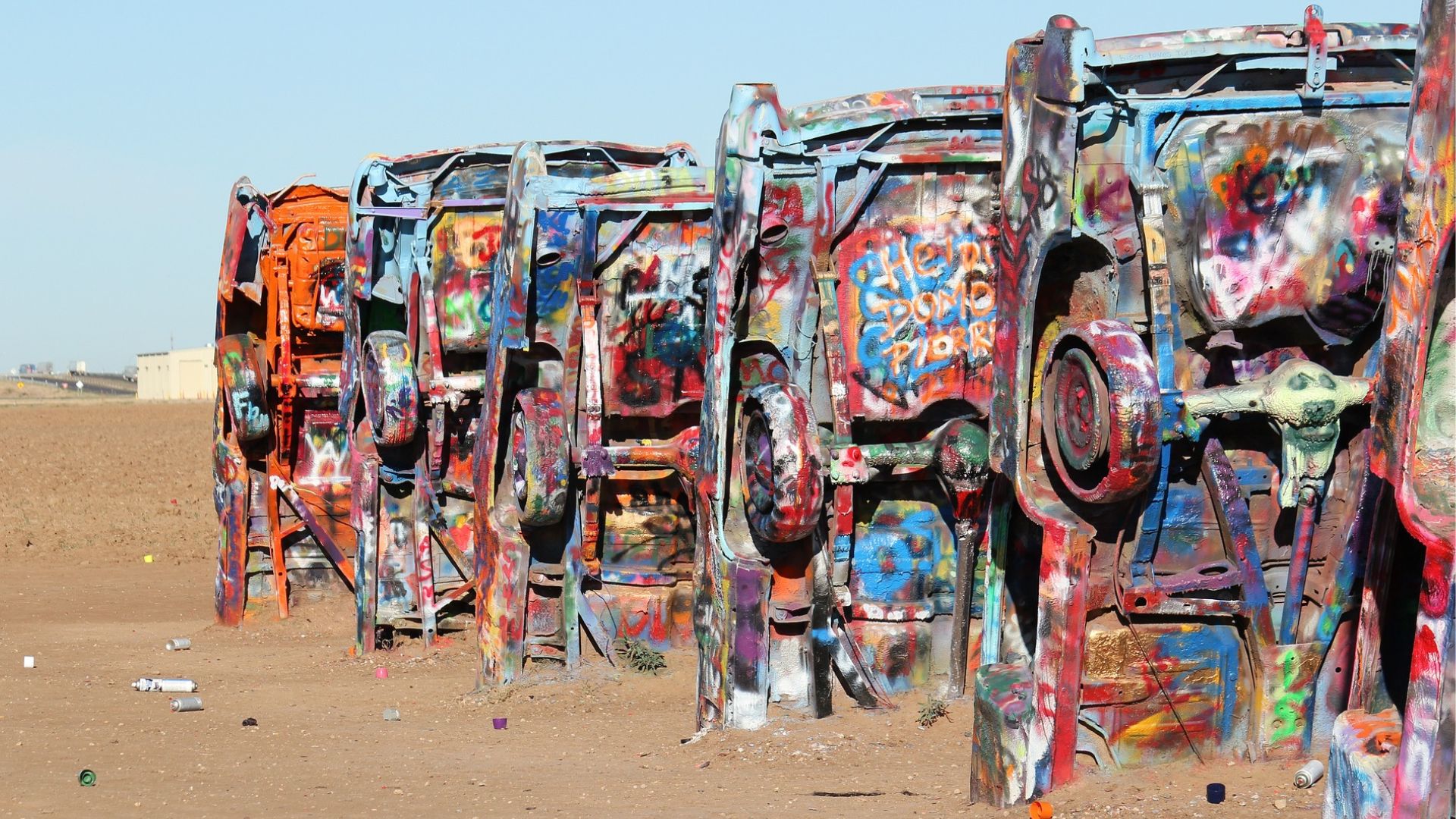
Short Excerpt
- The best roadside attractions turn necessary driving breaks into memorable parts of the trip, whether you stop for giant sculptures, folk art, historic landmarks, or classic Route 66 oddities.
- Favorites such as Cadillac Ranch, Carhenge, the Corn Palace, Wall Drug, the Blue Whale of Catoosa, and Lucy the Elephant can fit naturally into larger road-trip routes.
- Check access, hours, admission, parking, and seasonal restrictions before making a long detour because some roadside attractions are not simply open roadside displays.
Quick Take
- Choose roadside stops that add relatively little driving time unless the attraction is important enough to become a destination itself.
- Mix quick photo stops with longer attractions so every detour does not turn into another hour away from your route.
- Verify current access before leaving the highway, especially for privately owned, seasonal, or ticketed attractions.
- Give children and other passengers a few stops to choose so the road trip feels shared rather than scheduled entirely by the driver.
- Treat unusual roadside attractions as part of the journey instead of racing past everything between your starting point and final destination.
Make The Drive Part of the Vacation with Roadside Stops Worth Pulling Over For
A memorable road trip is not only about where you sleep at the end of the day.
Some of the best stories come from the places you almost drove past.
A field of half-buried Cadillacs outside Amarillo, a Stonehenge replica made from automobiles in Nebraska, an enormous blue whale beside old Route 66, or a six-story elephant near the Jersey Shore can give an otherwise routine driving day a personality of its own.
The key is choosing detours that fit the route rather than forcing every unusual attraction onto the itinerary.
Some stops need only 15 or 20 minutes for a walk, photos, and a stretch.
Others, including the Mystery Spot, Oregon Vortex, Solomon’s Castle, Wall Drug, and certain seasonal attractions, can occupy a meaningful part of the day.
Location matters just as much as novelty.
A quirky attraction located five minutes from your highway can be an easy decision, while something requiring an hour-long round-trip detour should offer enough experience to justify the lost driving time.
Roadside stops can also help break up long stretches behind the wheel.
Instead of relying only on gas stations and interstate rest areas, strategically placed attractions give everyone a reason to get out, walk around, reset, and experience something connected to the region.
Families can make the process even more engaging by allowing each traveler to choose one or two stops.
That keeps the itinerary from becoming a checklist and makes unexpected discoveries part of the fun.
Before committing to a detour, verify current hours, access rules, admission, parking, and seasonal conditions.
A roadside attraction may look permanently accessible on a map even when it sits on private property, operates only during certain seasons, requires a tour, or has changed since an older travel article was published.
The best road-trip stops do not compete with the destination.
They make the miles between destinations worth remembering.
Transform Ordinary Drives into Adventure: 25 Roadside Attractions That Demand a Stop
1. The World’s Largest Ball of Twine – Cawker City, Kansas
Cawker City might not be the first place you circle on a map, but its claim to fame is unforgettable: a massive ball of twine that locals have been adding to for decades.
What started as one man’s project in the 1950s slowly grew into a community effort, and today the twine ball weighs many tons and continues to expand.
Visitors are often invited to add a piece of twine, which means you’re not just looking at a record—you’re helping to keep it alive.
For someone passing through Kansas with no expectations, this stop feels surprisingly personal.
You step out for a leg stretch, learn a tiny slice of local history, contribute a strand if you like, and leave knowing you’re now part of a story that’s still being wound.
2. Cadillac Ranch – Amarillo, Texas
Outside Amarillo, a row of classic Cadillacs planted nose-down in a field looks so strange that people pull over just to confirm it’s real.
It is—and you’re encouraged to walk right up to the cars.
Layers of spray paint from generations of travelers cover every inch of metal.
Many people bring a can, add their name or design, and watch their fresh color blend into the next wave of road-trip art.
There’s no formal route or tour, just a short walk from the parking area and all the time you want to wander.
If you’ve never seen anything like it, Cadillac Ranch is a perfect first taste of “big, weird America.”
It’s quick to visit, easy for kids and adults to enjoy together, and you leave with photos that look nothing like another sunset highway shot.
3. Carhenge – Alliance, Nebraska
On the Nebraska plains, you’ll find a familiar circular shape made from very unfamiliar stones: full-size cars, buried and balanced to mirror Stonehenge.
Carhenge is exactly what it sounds like, but it still surprises you when you see it in person.
Walking through the ring, you notice the details—doors welded shut, windows removed, everything painted a dull gray to mimic weathered rock.
Smaller car sculptures scattered around the site add extra reasons to explore.
For a traveler who’s never even heard the name before, Carhenge turns a simple detour into one of the most memorable stops on the route.
It’s playful, a little surreal, and a reminder that creativity shows up in very unexpected places.
4. The Mystery Spot – Santa Cruz, California
Tucked into the redwoods near Santa Cruz is a spot where your sense of balance goes slightly haywire.
At the Mystery Spot, you walk into tilted rooms and stand on platforms where your eyes and inner ear stop agreeing with each other.
Guides demonstrate how balls appear to roll uphill and how people seem to change height depending on where they stand.
The explanations lean into both science and fun, so you can treat it as a puzzle, a joke, or a little of both.
If all you know is “there’s something weird in the woods,” this place more than delivers.
It’s compact, easy to add to a coastal drive, and it gives you a shared “how did that feel to you?” moment that keeps the conversation going long after you get back in the car.
5. The Enchanted Highway – Regent, North Dakota
Most people expect long, empty miles in this part of North Dakota.
What they don’t expect is a series of enormous metal sculptures rising out of the fields along a rural road.
That’s the Enchanted Highway.
Artist Gary Greff built giant pheasants, grasshoppers, a tin family, and more to draw visitors toward his hometown of Regent.
Each piece has its own turnout and parking area, so you can pull over, walk right up, and see how huge they really are.
Instead of one quick selfie stop, you get a full scenic drive punctuated by creativity.
For anyone who assumed this part of the state would be “just corn and sky,” the Enchanted Highway becomes the highlight of the day.
6. The World’s Largest Pistachio – Alamogordo, New Mexico
On the edge of Alamogordo, a towering pistachio stands next to a family-run farm and tasting room. It sounds like a joke until you’re standing at its base, looking up.
The fun part is that it isn’t just a statue.
You can tour the orchards, learn how pistachios grow in this landscape, and sample everything from simple roasted nuts to flavored mixes and local wines.
It’s a snack break, a mini-tour, and a photo stop in one.
For road-trippers who usually settle for gas-station chips, this is a big upgrade.
You step away with better snacks, a sense of the local agriculture, and a ridiculous—but excellent—picture with a giant nut.
7. Lucy the Elephant – Margate, New Jersey
Drive down the shore to Margate and you’ll suddenly see her: a six-story building shaped like an elephant facing the ocean.
Lucy looks whimsical from the outside, but there’s more going on here than a funny façade.
Guided tours take you inside and up through the structure to a viewing area, where you can look back over the beach and town.
Along the way you hear how Lucy has survived more than a century of storms, changes in ownership, and near-demolition to become a protected landmark.
For travelers who’ve never encountered her story, Lucy manages to be both charming and impressive.
You get architecture, history, and a coastal overlook wrapped up in one very photogenic stop.
8. The World’s Largest Frying Pan – Rose Hill, North Carolina
In Rose Hill, a gigantic frying pan signals just how seriously the town takes its poultry.
The pan is large enough to have cooked hundreds of chicken pieces at once during festivals, and it now stands as a monument to that tradition.
You don’t need more than a few minutes here, but it’s enough time to appreciate the scale, read about the town’s poultry heritage, and grab a quick group photo.
It’s often right on your way if you’re exploring eastern North Carolina.
For people who love small-town stories, this kind of stop is exactly what makes a road trip feel local instead of generic.
You step out, smile, learn a sentence or two of history, and keep going.
9. Foamhenge – Centreville, Virginia
Near Centreville sits a surprisingly convincing Stonehenge…made entirely from foam.
From a distance, Foamhenge really does resemble the original.
Up close, you see paint strokes and carved details that make the project feel more like a lovingly built movie set.
Visitors wander among the foam blocks, read humorous signs, and test angles for the best photos.
There’s no pressure to stay long; it’s designed as a light, fun break from the road.
For first-timers, Foamhenge hits that sweet spot between silly and impressive.
You walk away with a better mood, a few good pictures, and a story that starts with “You’re not going to believe this, but…”
10. The Corn Palace – Mitchell, South Dakota
Mitchell’s Corn Palace looks like a regular public building at first glance—until you notice that the murals on its exterior are made of corn and grains.
Every year, local artists and farmers redesign the artwork using multicolored ears and husks.
Inside, the building serves as an arena and community hub, with displays that explain how the region’s farms keep the place running.
You’re free to roam, check out the murals from different angles, and grab a snack or souvenir before continuing your drive.
If you’re new to this part of South Dakota, the Corn Palace is a wonderfully unexpected introduction.
It’s free, family-friendly, and a genuine point of pride for the town, not just a roadside gimmick.
11. The Blue Whale – Catoosa, Oklahoma
Just off old Route 66 in Catoosa, a bright blue whale lounges beside a pond as if it’s been waiting for you to arrive.
Originally built as a private anniversary gift, it became a beloved local swimming spot and, eventually, a public roadside attraction.
Today, visitors wander onto the whale’s broad back, peer into the mouth, and sit at nearby picnic tables while turtles and fish ripple the surface below.
It’s peaceful, low-key, and full of old-school roadside charm.
If you’ve been staring at endless highway, the Blue Whale is a soft landing.
You slow down, enjoy a shady, water-side pause, and leave feeling like you visited someone’s favorite neighborhood hangout rather than a commercial attraction.
12. Paul Bunyan and Babe the Blue Ox – Bemidji, Minnesota
On the shore of Lake Bemidji, you’ll find a towering lumberjack and his blue ox waiting by the water.
Paul Bunyan and Babe have been standing here since the 1930s, greeting visitors in search of tall tales and photo ops.
The statues connect you to both folklore and the real logging history of northern Minnesota.
Nearby signs and exhibits help bridge the gap between exaggerated stories and the very real work that built the region’s towns.
For travelers seeing them for the first time, Paul and Babe offer something simple and satisfying: a quick stop, great photos, and a little context for all the pine trees you’ve been driving past.
13. The Oregon Vortex – Gold Hill, Oregon
South of Grants Pass, there’s a hillside where everything feels subtly off.
At the Oregon Vortex, your height appears to change depending on where you stand, objects seem to roll the “wrong” way, and walking in a straight line can feel unexpectedly challenging.
Guided tours demonstrate optical illusions and explain the theories behind them, but the real appeal is how your own body reacts.
You can see the effect with your eyes and feel it in your balance at the same time.
Even if you arrive skeptical, it’s hard not to enjoy the experience.
The Vortex turns a simple roadside stop into a shared “did you feel that too?” moment that sticks with you.
14. The World’s Largest Ketchup Bottle – Collinsville, Illinois
In Collinsville, a huge red ketchup bottle towers above the neighborhood on a water-tower base.
Built as a working tank for a local ketchup company in the 1940s, it has become a symbol of the town’s tomato-processing days.
You can’t go inside the bottle, but you can park nearby, take photos from different perspectives, and read about how important the industry was to the area.
It’s quick, quirky, and hard to miss once you know it’s there.
If you’re road-tripping across Illinois, this is one of those easy wins: a short detour, a fun conversation starter, and another unusual landmark checked off your list.
15. Dinosaur Park – Rapid City, South Dakota
High on a hill above Rapid City, a set of bright green concrete dinosaurs looks out over town.
The figures date back to the 1930s, when America was fascinated by dinosaurs and roadside parks were taking off.
A short climb gets you to the top, where kids scramble around the dinosaur feet and tails, and adults enjoy sweeping views of the surrounding hills and city.
Information boards explain the park’s origins and why it was built.
If you’re new to the area, Dinosaur Park is a perfect leg-stretch stop—free, outdoors, and fun for mixed-age groups.
You get a bit of local history, a bit of kitsch, and a solid overlook in one go.
16. Salvation Mountain – Niland, California
Near the Salton Sea, the desert suddenly erupts into color: a painted hillside covered in words, flowers, and shapes.
This is Salvation Mountain, built by Leonard Knight over many years using adobe, straw, and countless gallons of paint.
Walking the paths, you see how thick the layers of paint have become and how many small details are tucked into every corner.
Volunteers and locals often share stories about Knight’s dedication and the amount of work it took to keep the mountain from collapsing or washing away.
Even if you arrive not knowing anything about it, the scale and color make an instant impression. It’s one of those places where you find yourself speaking in quieter tones, just out of respect for the time and effort poured into one person’s vision.
17. The Thing – Dragoon, Arizona
Drive along I-10 in Arizona and you’ll see billboard after billboard asking the same question: “What is The Thing?” By the time you reach the exit, curiosity usually wins.
Inside, a self-guided walk leads through themed exhibits—some historical, some odd, some tongue-in-cheek—that build toward the reveal.
When you finally meet The Thing itself, the reaction is half the fun.
You might think it’s creepy, hilarious, or delightfully strange.
For travelers seeing it for the first time, this stop is about the whole journey from first billboard to final display.
It turns a featureless highway into a mini-mystery with an ending you can finally stop speculating about.
18. Wall Drug – Wall, South Dakota
By the time you reach Wall, you’ve probably seen more Wall Drug signs than you can count: free ice water, five-cent coffee, donuts, dinosaurs, jackalopes.
It feels only fair to see what all the signs are about.
Inside, you find a sprawling mix of restaurants, shops, and themed corners.
There’s Western art, statuary, a splash area for kids, and enough souvenirs to keep everyone busy while you rest.
It’s part roadside stop, part indoor boardwalk, with plenty of seating for tired travelers.
If this is your first time in South Dakota, Wall Drug is almost a rite of passage.
You refuel, explore, and roll back onto I-90 feeling like you’ve checked off a classic stop rather than just another rest area.
19. The World’s Largest Cowboy Boots – San Antonio, Texas
Near San Antonio’s North Star Mall, a pair of cowboy boots taller than many buildings stands by the road.
They’re detailed, patterned, and impossible to miss once you’re in the area.
Visitors park, walk over, and quickly realize just how big they are—about 35 feet tall.
At night, lights make them stand out even more for photos.
Locals use them as a landmark, and travelers treat them as proof that they really are in Texas.
It’s not a long stop, but it’s a fun, visual way to mark your time in the city, especially if you’re already nearby for shopping, dining, or a hotel stay.
20. Solomon’s Castle – Ona, Florida
Down a quiet Florida back road, a shimmering structure appears between the trees.
Solomon’s Castle, created by artist Howard Solomon, is a home, gallery, and whimsical landmark wrapped in recycled metal panels.
Tours take you through rooms filled with sculptures built from old machinery, tools, and scrap—each one turned into something entirely new.
Outside, a quirky restaurant built into a faux “ship” on a moat adds to the sense that you’ve stepped into a private world.
For travelers discovering it for the first time, the castle is a reminder that some of the most interesting art spaces aren’t in big cities at all.
They’re hidden in plain sight along the roads most people drive past.
21. The Fremont Troll – Seattle, Washington
Under Seattle’s Aurora Bridge, a giant concrete troll clutches a real car in one massive hand.
The Fremont Troll looks like it might stand up and walk away at any moment, which is exactly why people come to see it.
You can climb the base, sit on its hands, or stand by its face for photos.
The setting under the bridge, combined with murals and indie shops around the neighborhood, gives the whole visit a creative, slightly offbeat feel.
For travelers new to the city, the troll adds a memorable, very local angle to a Seattle visit—something different from skyline views and standard downtown stops.
22. The Shoe Tree – Middlegate, Nevada
Along Nevada’s “Loneliest Road,” a single tree with its branches heavy with shoes announces that you’ve reached the Shoe Tree.
It’s startling the first time you see so many sneakers, boots, and sandals dangling overhead.
No two visitors tell the origin story quite the same, but everyone agrees on one thing: people keep adding shoes.
When the original tree was cut down, locals and travelers simply adopted a nearby tree and the tradition continued.
If you’re driving this remote stretch for the first time, the Shoe Tree feels like a little burst of community in the middle of the desert.
You can snap photos, read notes on shoes, and decide whether to contribute a retired pair of your own.
23. Hole N’ The Rock – Moab, Utah
Just south of Moab, a bold sign painted on the cliff hints that something unusual is hiding in the sandstone.
Hole N’ The Rock turns out to be a full fourteen-room home carved inside the rock itself.
Guides walk you through the cool interior, past original furnishings, artwork, and collections left by the Christensen family who spent more than a decade building it.
Outside, a small zoo, quirky sculptures, and a gift shop give you extra reasons to linger.
For anyone exploring Utah’s parks for the first time, this is a fascinating contrast.
You see the natural rock formations at Arches or Canyonlands, then step into a man-made space carved into similar stone by pure determination.
24. Gravity Hill – Bedford, Pennsylvania
In the hills near Bedford, there’s a stretch of road where your car appears to roll uphill when it’s actually coasting down a gentle slope.
Gravity Hill is a classic optical-illusion stop that feels like a science experiment you can run yourself.
You line up at the marked spot, put the car in neutral, and watch.
The surrounding landscape tricks your eyes into seeing a climb where there’s really a descent, so the slow movement feels wrong enough to be entertaining.
For families, this is an easy, interactive break that gets everyone out of “just driving” mode.
You try it, laugh, repeat it once more “just to check,” and then head on, satisfied that you’ve proved it to yourselves.
25. The Wigwam Motels – Holbrook, Arizona, and San Bernardino, California
Along old Route 66, the Wigwam Motels offer something you rarely see anymore: concrete teepee-shaped units arranged in a semicircle around a shared driveway.
Neon signs and vintage cars complete the retro scene.
Rooms inside are simple but comfortable, combining basic modern amenities with a very specific kind of nostalgia.
Stepping outside at night, with the structures lit and the sky overhead, feels like walking into a well-preserved postcard from the mid-20th century.
If you’ve never stayed anywhere like this before, a night at one of the Wigwam Motels turns a routine hotel stop into a trip highlight.
It’s not just where you slept; it becomes one of the “you’ve got to see this” stories you tell when you get home.
Make Every Mile Memorable: Roadside Attractions That Redefine the Journey
Most people remember the big endpoints of their road trips—the national park, the city skyline, the final beach.
What often gets overlooked is how much of the journey is made up of everything in between.
These attractions give that in-between time a purpose.
You don’t have to see all 25 in one go.
Instead, pick the ones that sit naturally along your route or cluster a few in a region you’re curious about—cars and highways in the Midwest, folk art in the Southwest, retro motels and gravity tricks along Route 66.
To keep the overall trip smooth:
- Use Booking.com, Trip.com, Agoda, or Tripadvisor to anchor your overnights before you go.
- Layer in city or nature days with tours from Viator, GetYourGuide, or Klook when you want someone else to handle the plan.
- In bigger cities, hop-on options from Big Bus Tours give your legs a break while still covering key sights.
- In compact towns, rentals from BikesBooking.com let you roll between murals, diners, and local attractions without repositioning the car.
- Keep your belongings organized with sturdy luggage from Travelpro, and your online life tidier with services like Incogni or a travel-ready VPN from NordVPN when you’re hopping between hotel and café Wi-Fi networks.
If airline disruptions affect the flights tied to your road trip, companies such as Compensair or AirHelp can review whether compensation is on the table, while coverage from World Nomads, VisitorsCoverage, Insubuy, or EKTA helps you recover non-refundable costs when plans change.
With the practical side handled and a few of these stops pinned on your map, you’re not just traveling from Point A to Point B.
You’re collecting stories—about twine and trolls, castles and ketchup bottles—that make the miles feel like the best part of the journey.
FAQ – Which Roadside Attractions Are Worth Pulling Off the Highway For?
What Makes a Roadside Attraction Worth the Detour?
A worthwhile roadside attraction gives you something memorable without disrupting the trip more than the experience justifies.
Quick stops such as giant sculptures, unusual buildings, public art, and Route 66 landmarks can provide a stretch break and memorable photos with relatively little commitment.
Larger attractions become worthwhile when the history, tour, exhibits, food, scenery, or overall experience gives you a reason to stay longer.
Compare the additional driving time with how much you genuinely want to see the attraction before automatically adding every unusual place to your route.Which Roadside Attractions on This List Are Easy Stops During a Road Trip?
Cadillac Ranch, Carhenge, the Blue Whale of Catoosa, the World’s Largest Ketchup Bottle, Dinosaur Park, the Fremont Troll, and several giant roadside sculptures can work well as shorter stops.
They let you get out of the vehicle, explore or take photographs, and continue the trip without necessarily devoting half a day.
Actual visit time still depends on parking, crowds, walking distance, and how interested you are in the site.
Keep one or two easy stops available on long driving days instead of filling every hour with scheduled attractions.Which Roadside Attractions Deserve More Time Than a Quick Photo Stop?
The Mystery Spot, Oregon Vortex, Wall Drug, Solomon’s Castle, Hole N’ The Rock, and similar attractions offer more than a single roadside object.
Tours, exhibits, restaurants, shops, grounds, or other activities can turn them into genuine itinerary stops.
The World’s Largest Pistachio can also become more than a photo opportunity when you explore the surrounding farm or shop.
Give these attractions enough time to enjoy what makes them distinctive rather than squeezing them between unrealistic driving deadlines.Which Roadside Attractions Are Especially Fun for Families?
Carhenge, the Corn Palace, Blue Whale of Catoosa, Dinosaur Park, Wall Drug, Lucy the Elephant, and the World’s Largest Pistachio can all give families a break from ordinary highway driving.
Their unusual shapes, oversized designs, interactive elements, or surrounding attractions give children something tangible to anticipate during a long day in the car.
Family suitability still depends on the child’s age, walking tolerance, weather, and how long you plan to stay.
Letting children choose one stop from the route can make them more invested in the journey.Which Stops Capture the Classic Route 66 Road-Trip Experience?
Cadillac Ranch near Amarillo and the Blue Whale of Catoosa are two of the strongest Route 66 connections represented on this list.
The Wigwam Motel experience adds another layer of Mother Road nostalgia because the distinctive lodging itself becomes part of the road trip.
These places reflect the oversized signs, unusual architecture, public art, and attention-grabbing attractions that became part of American highway culture.
A Route 66 itinerary becomes more interesting when you mix these famous stops with surviving diners, motels, historic businesses, and smaller towns along the way.Which Roadside Attractions Offer Some of the Most Unusual Photo Opportunities?
Cadillac Ranch gives you brightly painted cars rising from a Texas field, while Carhenge recreates a prehistoric monument with automobiles on the Nebraska plains.
Lucy the Elephant, the World’s Largest Pistachio, giant cowboy boots, the Fremont Troll, and Salvation Mountain produce completely different visual backdrops.
The Enchanted Highway provides several giant metal sculptures instead of a single stop.
Good photographs are a bonus, but allow enough time to actually experience the place instead of treating every attraction as another backdrop for a quick picture.How Can You Add Roadside Attractions Without Making a Road Trip Exhausting?
Limit the number of required stops and distinguish between attractions you definitely want to see and places you will visit only if time allows.
A good driving day might include one substantial attraction and several short breaks rather than five destinations that each require a strict arrival time.
Group stops that naturally follow your route instead of repeatedly leaving the highway in opposite directions.
Flexible planning leaves room for traffic, meals, weather, unexpected discoveries, and the occasional attraction that turns out to deserve more time than expected.Should You Plan Roadside Attractions Before the Trip or Find Them Along the Way?
Use both approaches.
Planning identifies major attractions that require tickets, tours, seasonal access, or a meaningful detour, while spontaneous stops preserve the sense of discovery that makes road trips enjoyable.
Save several optional attractions along the route before departure so you have choices when everyone needs a break.
Then verify important details before leaving the highway because access and operating conditions can change.Are Roadside Attractions Usually Free?
Many outdoor sculptures, public landmarks, and roadside displays can be viewed without an admission charge, but that is not true for every attraction on this list.
Tours, privately operated attractions, museums, farms, seasonal events, and entertainment complexes may charge admission or require tickets.
Parking or associated activities can also add costs even when viewing the main roadside object is free.
Check the current attraction information before arriving rather than assuming the phrase “roadside attraction” means there is nothing to pay.What Should You Check Before Driving Out of Your Way for a Roadside Attraction?
Confirm the location, hours, admission, parking situation, seasonal schedule, and whether visitors can currently access the attraction.
Look at the additional driving time in both directions because a place described as “near” the highway may require a much longer detour than expected.
Weather and daylight can also affect outdoor attractions, particularly when the experience depends heavily on walking or photography.
A two-minute check before changing course can prevent a memorable detour from becoming a locked gate, closed attraction, or unnecessary hour of driving.