
Make the Most of Your Trip
Compare the top tours, passes, and experiences — find what fits your travel style.
Short Excerpt
- Eating healthy on the road gets easier when you plan for the moments that usually force convenience choices: long drives, airports, train stations, hotel mornings, and delayed meals.
- Portable snacks, regular hydration, simple grocery stops, and a cooler for road trips can give you better options without requiring every meal to be carefully planned.
- Healthy travel eating should leave room for local restaurants and regional specialties, with everyday meals providing the balance that keeps your energy more consistent.
Quick Take
- Pack portable foods such as nuts, roasted chickpeas, whole-grain crackers, fruit, and suitable protein bars so unexpected delays do not leave you dependent on the nearest snack counter.
- A small cooler can expand road-trip options to yogurt, cheese, hummus, cut vegetables, hard-boiled eggs, and other foods that need refrigeration.
- At airports, stations, and roadside stops, look for grilled proteins, wraps, salads, grain bowls, fruit, yogurt, or other choices that provide more than a quick sugar hit.
- Use hotel mini-fridges, rental kitchens, grocery stores, and farmers markets to create a few simple meals instead of relying on restaurants for everything.
- Enjoy the local food you traveled to experience, then balance richer meals with lighter choices rather than treating vacation eating as all-or-nothing.
- Keep water accessible throughout long travel days, especially when extensive walking, heat, or changing schedules make it easy to forget to drink.
Eat Healthy On The Road Without Turning Every Travel Meal Into A Nutrition Project
Travel days are where good eating intentions usually get tested.
A delayed flight, hours on the highway, an early train, a hotel breakfast buffet, or a missed lunch can leave you hungry enough that the closest food becomes the automatic choice.
The solution is not to plan every bite before leaving home. It is to give yourself enough dependable options that hunger, convenience, and a disrupted schedule do not make every decision for you.
Start with what travels easily.
Nuts, roasted chickpeas, whole-grain crackers, fruit, dried fruit without excessive added sugar, nut butter packets, and suitable protein bars can buy you time when a real meal is still hours away.
Road trips give you even more flexibility because a small cooler can hold foods such as yogurt, cheese, hummus, cut vegetables, hard-boiled eggs, sandwiches, or other refrigerated items.
That turns a gas-station stop from your only meal option into just one possibility.
Where you stay can also make healthy eating easier.
A hotel mini-fridge gives you room for fruit, yogurt, vegetables, and leftovers, while a rental with a kitchen lets you prepare a simple breakfast or occasional meal without giving up local restaurants.
Airports and train stations require a different strategy.
Look beyond the first fast-food counter for wraps, salads, grain bowls, grilled proteins, fruit cups, yogurt, or other combinations that can keep you satisfied through the next leg of the journey.
None of this means skipping the food that makes travel memorable.
Eat the pasta in Rome, the sushi in Tokyo, the pastry in Paris, or the regional specialty you may never find prepared the same way at home.
The goal is balance across the entire day.
When ordinary breakfasts, snacks, and transit meals support you well, there is much more room to enjoy the restaurant, market, or street-food experience you actually traveled for.
Pack Smart: Snacks That Travel Well
The first rule of eating healthy on the road is simple: don’t leave your hunger to chance.
Airports, train stations, and roadside stops are designed for impulse.
If you arrive hungry, you’ll grab whatever’s closest.
That’s why packing snacks is your first line of defense.
Choose foods that are portable, non‑perishable, and nutrient‑dense.
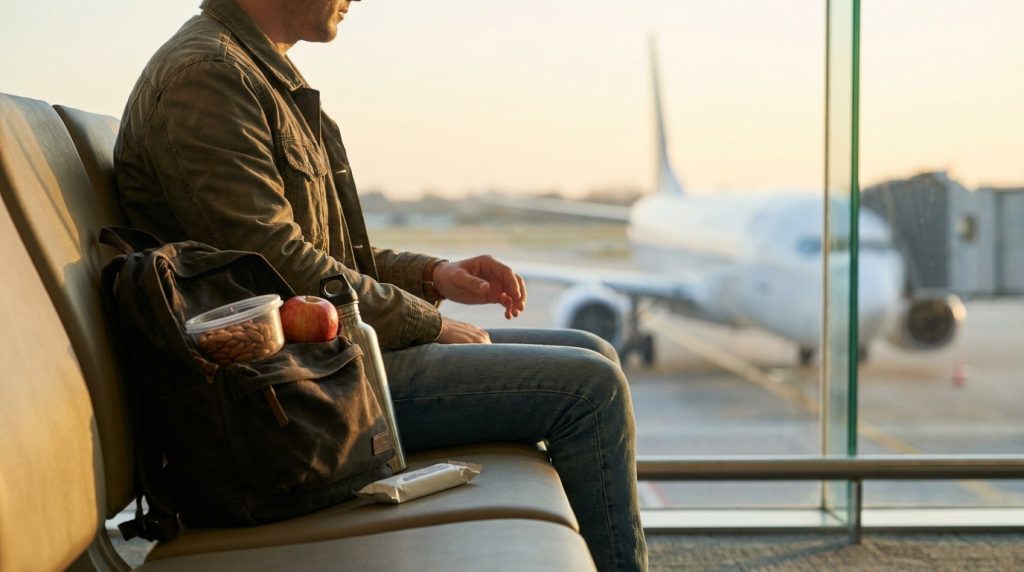
Nuts, roasted chickpeas, whole‑grain crackers, dried fruit without added sugar, and protein bars with clean ingredients all travel well.
Fresh fruit like apples, oranges, or bananas can survive a day in your bag.
Hard‑boiled eggs or string cheese work for shorter trips if you have a cooler.
These snacks do more than fill you up.
They stabilize your blood sugar, keep your energy steady, and prevent the crash that leads to poor decisions.
Picture yourself on a long layover.
The food court is filled with fried options.
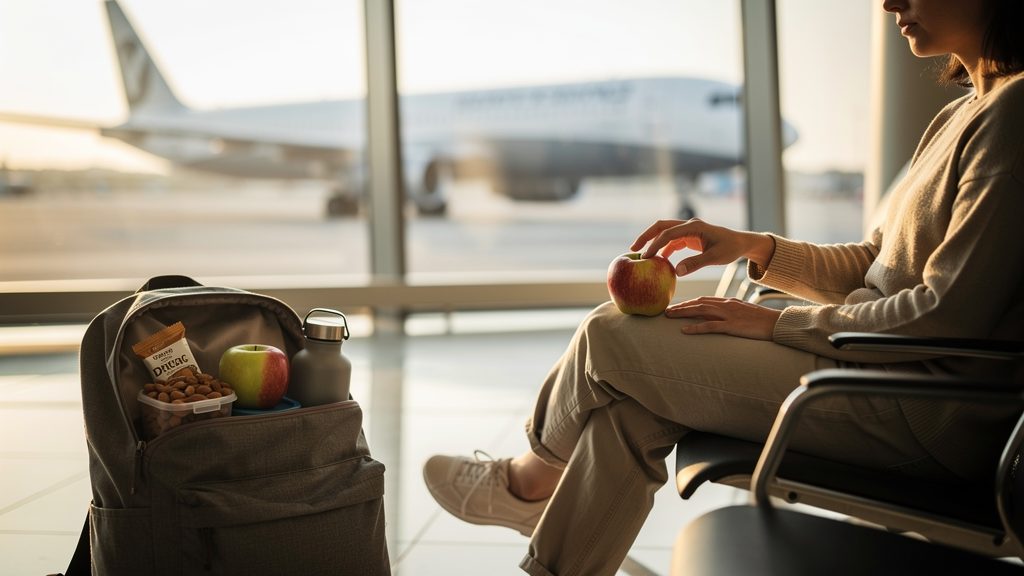
But you reach into your bag, pull out almonds and an apple, and suddenly you’re not desperate.
You can wait until you find a real meal.
Recap – Smart Snacks:
- Pack protein and fiber for steady energy.
- Choose portable, non‑perishable options.
- Snacks buy you time to make better choices.
Hydration: The Overlooked Travel Hack
Food gets all the attention, but hydration is just as important.
Dehydration makes you tired, irritable, and more likely to crave sugar.
It also worsens jet lag.
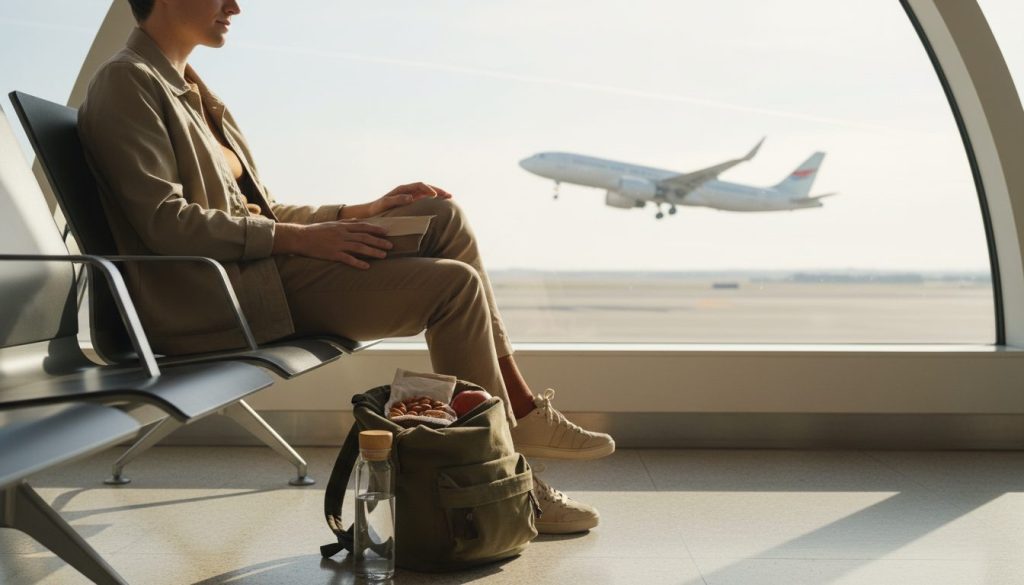
The solution is simple: carry a reusable water bottle.
Fill it at the airport, refill it at restaurants, and sip consistently throughout the day.
Choose water over soda or juice.
Limit alcohol and caffeine, especially on travel days, since both dehydrate you.
Imagine stepping off a plane after a long flight.
Most passengers feel sluggish, but you’ve been sipping water steadily.
You feel clearer, lighter, and ready to explore.
Recap – Hydration Anchors:
- Carry a reusable bottle.
- Choose water over sugary drinks.
- Hydration reduces cravings and jet lag.
Hotels and Airbnbs: Control Your Environment
Where you stay shapes how you eat.
Hotels often tempt you with buffets heavy on pastries and fried foods.
Airbnbs give you kitchens but require planning.
The key is to take control.
If you’re in a hotel, ask for a mini‑fridge and stock it with yogurt, fruit, and pre‑washed vegetables.
If you’re in an Airbnb, visit a local grocery store or farmers market.
Buy simple staples: eggs, oats, fresh produce, lean proteins.
Even one healthy meal a day—like a breakfast you prepare yourself—anchors your nutrition.
Picture yourself in Paris.
Instead of croissants every morning, you start the day with yogurt, berries, and oats in your Airbnb kitchen.
Later, you enjoy a croissant as a treat, not a default.
Recap – Accommodation Anchors:
- Ask for a fridge in hotels.
- Shop local groceries in Airbnbs.
- One healthy meal a day sets the tone.
Airports and Travel Days: Navigating the Gauntlet
Airports are designed for convenience, not health.
But even here, you have choices.
Look for salads, wraps, or grain bowls.
Choose grilled or baked proteins over fried.
Skip heavy sauces and opt for vinaigrettes.
If you’re on the road, pack a cooler with hard‑boiled eggs, cut vegetables, and hummus.
Gas stations now stock healthier options like yogurt, cheese plates, and fruit cups.
It takes awareness, but the options are there.
Recap – Travel Day Anchors:
- Seek grilled, baked, or steamed options.
- Avoid heavy sauces and fried foods.
- Pack a cooler for road trips.
Restaurants: Balance Without Deprivation
One of the joys of travel is food.
You don’t want to miss out on local cuisine.
The key is balance.
Order dishes that highlight vegetables, lean proteins, and whole grains.
Share indulgent dishes so you can taste without overdoing it.
Eat slowly, savoring each bite.
And remember: one indulgent meal won’t ruin your trip.
It’s the pattern that matters.
Picture yourself in Tokyo.
You enjoy sushi with fresh fish and vegetables, then share tempura with friends.
You leave satisfied, not stuffed.
Recap – Restaurant Anchors:
- Prioritize vegetables and lean proteins.
- Share indulgent dishes.
- Eat slowly and savor.
Rituals That Keep You Grounded
Healthy eating while traveling isn’t just about food.
It’s about rituals that keep you grounded.
Start your day with a balanced breakfast.
Carry snacks so you’re never desperate.
Hydrate consistently.
End your day with a calming ritual—tea, journaling, or a short walk.
These habits create stability in the chaos of travel.
Recap – Ritual Anchors:
- Begin with a balanced breakfast.
- Carry snacks and hydrate.
- End with a calming ritual.
Nourishment on the Road: How Healthy Eating Transforms Travel
Eating healthy while traveling isn’t about restriction.
It’s about nourishment.
It’s about giving your body what it needs so you can fully experience the world.
When you eat well, you have the energy to climb the steps of the Acropolis, wander the streets of Marrakech, or hike the trails of Patagonia.
Healthy eating doesn’t take away from travel—it enhances it.
Because the best journeys aren’t just about where you go.
They’re about how you feel when you get there.
FAQ – How Do You Eat Healthy on the Road When Travel Keeps Disrupting Your Routine?
What Are the Best Foods to Pack for Long Travel Days?
Choose foods that are portable, easy to eat, and filling enough to keep you from becoming extremely hungry between meals.
Nuts, roasted chickpeas, whole-grain crackers, fruit, dried fruit, nut butter packets, and suitable protein bars travel well without much preparation.
For a road trip with a cooler, you can add yogurt, cheese, hummus, vegetables, hard-boiled eggs, and sandwiches.
The best travel snack is one you will actually eat before hunger pushes you toward whatever happens to be closest.How Can a Cooler Make Road-Trip Eating Easier?
A cooler dramatically expands what you can bring safely on a driving day.
Instead of relying entirely on shelf-stable snacks, you can pack refrigerated foods such as yogurt, cheese, hummus, cut vegetables, eggs, fruit, and prepared meals.
That makes it easier to stop when you want rather than organizing the entire day around restaurants or gas stations.
Keep cold foods properly chilled and replace ice or cold packs as needed during longer trips.What Should You Eat at Airports and Train Stations?
Look for a meal that combines something filling with foods you actually enjoy.
Grilled proteins, wraps, salads, grain bowls, soups, yogurt, fruit, and sandwiches can all work depending on what the terminal offers.
When possible, add vegetables or fruit instead of building the entire meal around fried sides or sweets.
Carrying a backup snack gives you more freedom to wait for a better option when the first food court is disappointing.How Can You Eat Better When Staying in a Hotel?
Use the room to create at least a few predictable food options.
A mini-fridge can hold yogurt, fruit, vegetables, drinks, and restaurant leftovers, while shelf-stable foods can cover snacks or a simple breakfast.
If the hotel offers breakfast, look for combinations such as eggs, oatmeal, fruit, yogurt, nuts, or whole-grain toast when available.
You do not need to prepare every meal yourself for the room to make eating on the road easier.Is A Vacation Rental Better For Healthy Eating?
It can give you more control because a kitchen or kitchenette allows you to prepare food when restaurant meals become repetitive or inconvenient.
A quick grocery-store or farmers-market visit can supply eggs, oats, fruit, vegetables, bread, yogurt, and other simple staples.
Even preparing breakfast or one lighter meal each day can reduce how often you have to search for food.
The kitchen works best as an option rather than an obligation that keeps you from experiencing local restaurants.How Do You Enjoy Local Food Without Abandoning Healthy Habits?
Treat local food as part of the travel experience instead of something you have to compensate for.
Order the regional dish, dessert, market specialty, or restaurant meal that genuinely interests you.
Then let another meal that day be simpler if that feels better for your energy and appetite.
Balance over several meals is far more practical on vacation than expecting every plate to follow the same rules.How Can You Remember to Drink Enough Water While Traveling?
Keep water somewhere you can reach it easily.
A refillable bottle works well where drinking water is safe and refill stations are available, while bottled water may be more appropriate in destinations where tap-water quality is uncertain.
Long drives, flights, extensive walking, and hot weather can make it easier to fall behind without noticing.
Build drinking into regular moments such as meals, fuel stops, boarding, hotel departures, and sightseeing breaks.What Should You Buy at a Grocery Store During a Trip?
Choose foods that solve the gaps between restaurant meals.
Fruit, yogurt, nuts, hummus, vegetables, bread, cheese, oatmeal, simple sandwiches, and ready-to-eat items can cover breakfast, snacks, or a lighter meal.
Local supermarkets and markets can also introduce you to regional foods without the price or formality of a restaurant.
Buy realistic quantities so you are not throwing away food when you change hotels or continue to another destination.How Can You Eat Well When Travel Delays Ruin Your Meal Schedule?
Use backup food to bridge the delay rather than waiting until hunger becomes urgent.
A snack containing something filling can carry you through a late flight, traffic jam, missed connection, or restaurant closure.
Once you reach a proper meal, eat normally instead of treating the disruption as a reason to overcorrect.
Planning for delays works better than assuming the itinerary will always leave enough time for food.What Is the Simplest Healthy-Eating Strategy for a Long Trip?
Protect the routine meals and stay flexible with the memorable ones.
Keep portable snacks and water available, use grocery stores when convenient, make use of a hotel fridge or rental kitchen, and choose reasonably balanced meals during transit.
Then enjoy the foods that are genuinely part of the destination without treating them as mistakes.
Healthy eating on the road works best when it supports the trip instead of becoming another itinerary you have to follow.