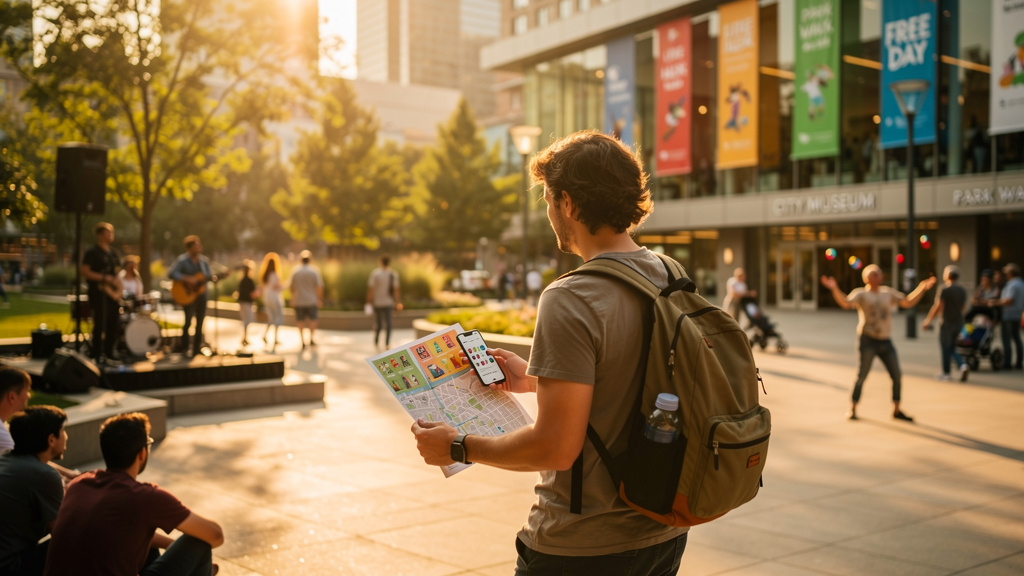

Make the Most of Your Trip
Compare the top tours, passes, and experiences — find what fits your travel style.
Short Excerpt
- Finding genuinely free things to do in a city becomes much easier when you know where locals and institutions actually publish events, museum access, park programs, public performances, and community activities.
- Municipal calendars, tourism offices, libraries, universities, museums, park conservancies, arts organizations, and neighborhood publications are often more reliable than endlessly scrolling generic event apps.
- The best strategy is to build a small list of dependable sources, verify details shortly before you go, and mix scheduled events with parks, public art, self-guided walks, and other options that do not require a ticket.
Quick Take
- Start with official city, tourism, library, university, museum, and park calendars because they tend to provide the most dependable information about free public programming.
- Verify dates, meeting points, entry requirements, and capacity 48–72 hours before an event so an outdated listing does not waste part of your trip.
- Look for scheduled museum free days, university galleries, outdoor sculpture routes, public parks, waterfronts, lectures, concerts, and family programs before paying for another attraction.
- Treat apps and social media as discovery tools rather than final confirmation, then verify promising events with the organizer or official venue.
- Tip-based walking tours are inexpensive ways to add local history and context, but budget a voluntary tip rather than treating them as literally cost-free.
- Leave room for street performers, public art, neighborhood markets, and other spontaneous city experiences that can become some of the most memorable parts of the trip.
Find Free Things To Do In Any City Without Wasting Your Vacation On Bad Listings
A city can offer far more free experiences than most visitors ever find.
Public concerts, museum admission windows, guided park walks, university galleries, neighborhood festivals, lectures, street performances, waterfront trails, public art, and community events may all be happening within a few miles of your hotel without appearing on the attraction lists tourists normally search first.
The challenge is not simply finding the word “free.”
It is finding activities that are current, worth your time, open to visitors, and actually happening when the listing says they are.
Start with the sources closest to the people organizing the experience.
Municipal event calendars, tourism offices, libraries, universities, museums, park departments, conservancies, arts councils, and neighborhood publications tend to provide better signals than scrolling through dozens of loosely maintained event listings.
Build a short source list for each destination and reuse it during the trip.
Checking four or five dependable calendars once a day can reveal outdoor concerts, family programs, free museum hours, guided walks, lectures, volunteer activities, and local events without turning free-activity hunting into another full-time travel task.
Then verify anything important before building your day around it.
Confirm the date, start time, meeting location, admission requirements, reservation rules, and any weather-related changes roughly 48–72 hours beforehand, particularly when an event is seasonal or has limited capacity.
Parks and waterfronts are among the easiest places to start because they give you something worthwhile even when no scheduled event is happening.
Trail maps, interpretive signs, conservancy calendars, ranger programs, volunteer events, and public art can turn an ordinary walk into several hours of sightseeing without an admission charge.
Museums and cultural institutions require more timing but can produce much larger savings.
Look for sponsored admission days, recurring free evenings, university galleries, outdoor sculpture collections, cultural festivals, and other programs designed to broaden public access.
Walking tours and meetups add another layer when you want local context or company.
Volunteer-led groups may genuinely cost nothing, while tip-based tours let you decide what the experience was worth afterward and should be treated as low-cost rather than completely free.
Apps and social platforms can help uncover pop-up markets, concerts, photography walks, language exchanges, and neighborhood events, but do not rely on an old post or stale listing.
Recent organizer activity, updated event details, clear meeting information, and confirmation from an official source are much better indicators that you should actually show up.
Finally, leave some unscheduled space.
A street musician, public performance, mural corridor, lively plaza, waterfront sunset, or community market you discover while walking can become one of the best memories of the city precisely because you did not buy a ticket or plan every minute beforehand.
Discover Free Events That Locals Actually Attend
Municipal calendars, tourism sites, and library listings are where reliably scheduled community programming lives; start there and you skip the guesswork.
Local weeklies and neighborhood bulletin boards will surface the smaller, curated happenings that apps often miss, so treat them as valuable complements.
Make a short, repeatable source list and check it the same way every day; a predictable habit beats sporadic searches.
Before you commit, confirm event details 48–72 hours out—most community organizers update close to the date and that little check prevents wasted trips.
Free events tend to prioritize participation and connection, so show up ready to engage rather than just spectate.
This approach turns random browsing into dependable plans that actually feel like local living.
How To Read Local Event Calendars For Reliable Finds
Municipal and institutional calendars indicate which events are civic or regularly funded, making them the most consistent sources for meaningful programming.
When an event repeats on the same calendar you can infer venue access, organizer capacity, and a good chance it will run as posted.
Include organizer contact and venue address as minimum filters to avoid surprises.
Run your check in a fixed order—municipal, institutional, local outlet, one social channel—and you’ll quickly learn which sources matter in each place.
City Calendar Context and Practical Signals
- Municipal/tourism calendars: highest reliability for scheduled public programming.
- Libraries/universities: recurring lectures, family programming, and panels.
- Local publications and bulletin boards: hyperlocal pop‑ups and niche shows.
- Actionable routine: build a four‑item source list and check it once daily; confirm 48–72 hours before.
Explore Nature That Doesn’t Require a Ticket

Public parks and waterfront promenades are the city’s easiest, most reliable gifts—no entry fee, flexible time, and a big emotional payoff.
Look for maintained trails, interpretive signage, and conservancy‑hosted events; those are the cues that a park is actively cared for and likely to offer programmed experiences.
If you want both solitude and structure, pair a short walk with a posted interpretive walk or a volunteer day—conservation groups often run short, focused activities that deepen a single visit.
Sign up for conservancy newsletters or check municipal park pages to time your visit for guided moments rather than hoping you’ll stumble into something.
This small bit of planning converts a pleasant stroll into a layered experience that feels deliberately chosen.
In practice, parks are the highest‑return, lowest‑risk item on any free‑activity list.
Where Urban Green Space Delivers The Biggest Return
Parks are civic design that became public benefit; places with active stewardship are where free programming actually happens.
Visible markers—interpretive panels, volunteer kiosks, and a public events calendar—predict scheduled walks and family programming.
When you time a visit to align with those cues you get nature plus curated context.
Subscribe to a conservancy newsletter and map a short route that pairs quiet time with a single programmed moment.
Practical Ways to Maximize Park Visits
- Scout trail maps ahead of time to find restrooms, access points, and viewing platforms.
- Check conservancy calendars for interpretive walks and volunteer days.
- Time visits for early morning or late afternoon to balance quiet and activity.
- Use park newsletters to discover guided programming and family events.
Visit Museums and Cultural Spaces Without Paying Admission
Many museums open for free at scheduled times because sponsorships and outreach budgets exist precisely to broaden access.
Rather than waiting for chance, collect newsletters from a few core institutions and scan them once a week so free windows stop being surprises and become part of your plan.
University galleries and outdoor sculpture routes are lower‑friction cultural anchors you can sequence around paid exhibits.
Reciprocal programs and sponsored free days let you stitch multiple venues into a single, culturally rich day without spending on entry.
Use institutional calendars to confirm entry rules—ID, timed tickets, or residency requirements—so you don’t arrive to a closed door.
With a little head‑work you can turn intermittent free access into reliable cultural days.
Timing And Channels That Unlock Free Access
Recurring free windows are a reliable signal of institutional commitment; sponsor names and municipal partnerships are the stabilizing clues you should look for.
Outdoor sculpture routes and university galleries are dependable, low‑effort options to anchor a cultural itinerary.
Collect the right newsletters into one folder and scan weekly to convert sporadic offers into dependable plans.
Prioritize venues that publish repeat free days rather than one‑off promotions to avoid wasted travel time.
How Museum Access Programs Work (summary and expansion)
- Funded outreach: sponsorships and municipal partnerships underwrite community nights and free entry.
- Reciprocal programs: multi‑institution access during specified dates.
- Outdoor art and university galleries: consistent, low‑friction options for cultural exposure.
- Action: subscribe to museum newsletters; scan calendars one week ahead.
Join Tours and Meetups That Don’t Cost a Cent
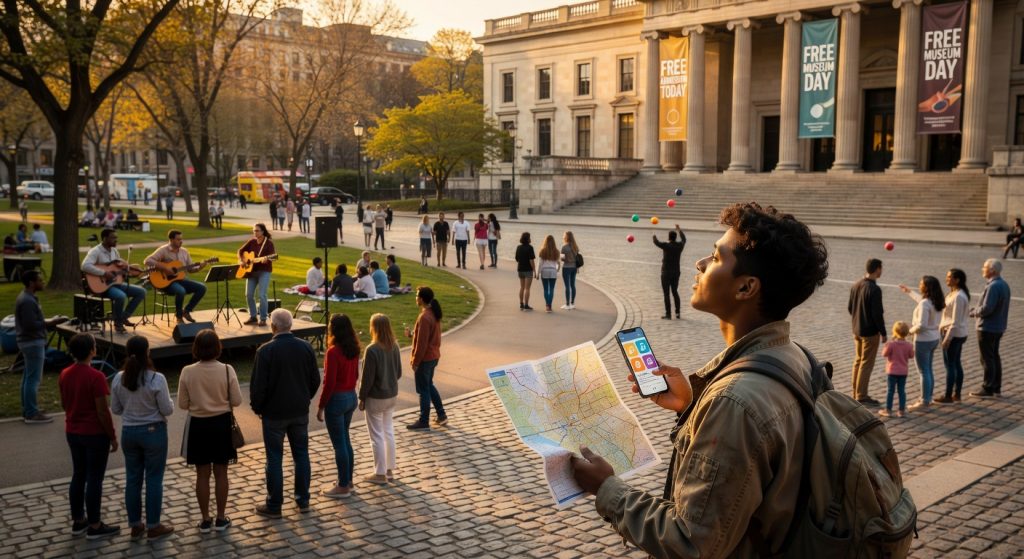
Tip‑based walking tours and volunteer‑led meetups are where local storytelling happens; they turn a route into a narrative and strangers into a brief community.
These formats surface neighborhood history, public‑art context, and foodway knowledge in ways a solo search rarely captures.
Meetups for photography, language exchange, or volunteering convert curiosity into recurring connections that last beyond a single afternoon.
To avoid friction, choose listings with clear meeting points, transparent formats, and published reviews; that small vetting step prevents most on‑site headaches.
Confirm logistics the day before, arrive early, and bring a modest tip if the experience feels valuable—the exchange sustains the ecosystem.
Use tours and meetups as a route to useful local recommendations you can act on immediately.
Vetting Tours And Meetups For Depth And Trust
Verified platform listings and consistent reviews indicate that a tour is repeatable and the guide understands the route and audience.
Clear meeting descriptions, estimated duration, and a quick host line (even a social handle) materially reduce on‑the‑ground uncertainty.
Grassroots listings can offer deeper neighborhood perspective; just send a one‑line message the day prior to confirm.
Combine platform signals with that single host check and you’ll get authenticity without drama.
Tactical Steps for Joining Tours and Meetups
- Vet meeting point, expected duration, guide reviews, and group size.
- Message the host with one clarifying question the day prior.
- Bring a voluntary tip and water to support guides and stay comfortable.
- Capture one local recommendation from the guide for immediate follow‑up.
Use Apps That Surface Free Fun Reliably
Apps are excellent for discovery but they’re noisy; treat them as accelerants rather than final authority.
Filter for cost, category, and date to reduce irrelevant listings and surface genuinely free programming.
Recent user photos, clear host profiles, and fresh timestamps are the signs that a listing is active and worth attending.
Set keyword alerts for the program types you care about—community concert, public lecture, family day—and review the digest once daily.
Always open the host or municipal page from the app listing before you leave; those pages control scheduling.
A compact app stack plus one small verification step yields far more reliable outcomes than dozens of unchecked alerts.
App Signals That Separate Noise From Good Events
Filters remove clutter, social proof confirms recent activity, and host pages validate access and timing; use all three before you commit.
Keep a minimal app stack and a verification habit to stop notifications from becoming noise.
Set a single daily digest window so discovery remains productive rather than disruptive.
App Workflow and Deployment Tips
- Use focused filters: cost, date, and category to reduce false positives.
- Validate with user photos and host profiles for recent activity.
- Cross‑check with municipal or host pages to confirm time and access.
- Action: maintain a two‑app stack and set keyword alerts to avoid overload.
Embrace Street Culture and Public Performance Responsibly
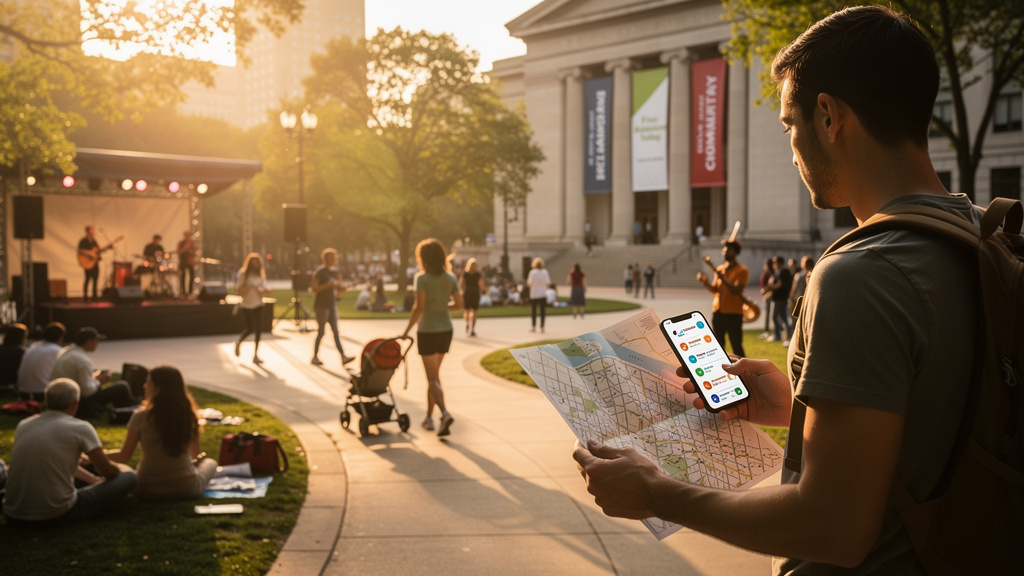
Street performers, pop‑up art, and informal markets are immediate, human moments that reveal a neighborhood’s voice.
Cities regulate these activities through permits and designated zones so the presence of posted signage usually means the programming is legitimate and organized.
When you arrive, be mindful: don’t block walkways, keep a respectful distance, and lend support by tipping or buying a small item when moved.
That small, local reciprocity keeps performers and vendors active and the public realm lively.
Check municipal arts pages to find sanctioned activations and to understand basic etiquette before you go.
A modest purchase or a generous tip sustains a program you’ll likely remember more than a paid show.
Recognizing Legitimate Street Programming And How To Engage
Posted permits, vendor zones, and visible crowd management usually indicate sanctioned and safe street programming.
Arts councils and cultural districts often sponsor activations; their pages point to higher‑quality events.
Courteous behaviors—don’t block traffic, keep volume reasonable, tip when appropriate—help programming continue without friction.
Use municipal listings to find where and when the best, lawful activations take place.
How to Support Street Culture Without Disrupting It
- Don’t block thoroughfares; keep reasonable distance from performers.
- Tip performers, buy a vendor item, or leave a positive review when appropriate.
- Use posted signage to find official performance times and permitted areas.
- Consult local arts council pages for scheduled activations and codes of conduct.
FAQ – Where Are the Best Free City Experiences Hiding — And How Do You Find Them Before Everyone Else?
Where Should You Look First for Free Events in a City?
Start with official municipal, tourism, library, university, and cultural-institution calendars.
These sources frequently list public concerts, lectures, workshops, family programs, festivals, exhibitions, and other community events that may never appear prominently on major travel websites.
Local publications and neighborhood newsletters can then fill in smaller happenings that official calendars miss.
Using a few dependable sources repeatedly is more effective than searching the entire internet from scratch every morning.How Do You Know Whether a Free Event Listing Is Still Accurate?
Verify the details with the organization actually hosting the event.
Check the current date, time, venue, meeting point, capacity limits, reservation requirements, and any weather notices before leaving your hotel.
A final check roughly 48–72 hours beforehand can catch schedule changes that older listings have not reflected.
Recent posts, organizer contact information, and updated venue pages are stronger signs than an event listing that has not been touched in weeks.What Are the Easiest Free Outdoor Activities to Find in A City?
Public parks, waterfront promenades, urban trails, gardens with free access, public art routes, and scenic neighborhoods are reliable starting points.
Look for interpretive signs, mapped trails, viewing areas, ranger programs, or conservancy events that add more structure to the visit.
Early morning and late afternoon can also give you a different atmosphere without changing the price.
A well-chosen park can provide several hours of sightseeing, exercise, photography, and local context for nothing more than the cost of getting there.How Can You Visit Museums Without Paying Full Admission?
Look for recurring free days, sponsored evenings, community-access programs, university galleries, and outdoor museum spaces.
Some institutions require timed reservations even when admission is free, while others restrict particular programs to residents or specific groups.
Checking the museum’s current calendar before arriving prevents confusion at the entrance.
Planning around a scheduled free window can turn one of the more expensive parts of a city itinerary into a no-admission-cost experience.Are Free Walking Tours Really Free?
Some volunteer-led walks genuinely have no required charge, but many so-called free walking tours operate on a tip-based model.
You join without paying a fixed ticket price and decide afterward what the guide’s time and knowledge were worth to you.
That can still be an inexpensive way to learn neighborhood history, public-art stories, architecture, and local recommendations.
Budget a reasonable voluntary tip so the experience does not become an unexpected expense at the end.Which Apps and Online Tools Are Best for Finding Free Things to Do?
Event apps, social networks, map tools, and community platforms can all be useful discovery sources.
Use filters for date, location, category, and price so genuinely free activities are not buried beneath paid promotions.
Recent photos, active host profiles, updated timestamps, and detailed meeting information can help separate current listings from abandoned ones.
Once something looks promising, confirm it with the organizer, venue, or official city calendar before building your itinerary around it.Where Can Families Find Free Activities for Children?
Libraries and community centers are especially useful because they frequently offer storytimes, workshops, crafts, performances, and educational programs.
Parks departments, museums, universities, and local festivals can add free family days and seasonal activities.
Some programs require advance registration even when there is no admission charge.
Checking family calendars early gives you more choices than waiting until the children are already asking what there is to do.How Can You Experience Street Culture Without Paying for a Formal Attraction?
Look for public performance areas, arts districts, plazas, mural corridors, permitted vendor zones, and scheduled cultural activations.
Street musicians, pop-up art, dance, and neighborhood markets can reveal a side of the city that traditional attractions rarely reproduce.
Be mindful of walkways and other spectators, and support performers or vendors when something genuinely adds to your experience.
Free access does not mean the people creating the experience should automatically be treated as though their work has no value.Can Volunteering Lead to Interesting Free Travel Experiences?
Yes.
Park conservancies, neighborhood organizations, environmental groups, and community projects sometimes organize cleanups, restoration days, guided activities, or other volunteer events.
These programs can introduce you to residents and parts of a destination you might never experience as a conventional tourist.
They work best when you actually want to contribute rather than treating volunteering solely as a way to obtain free entertainment.
A short community activity can still become one of the more personal experiences of the trip.What Is the Simplest System for Finding Free Activities in Every City You Visit?
Create a repeatable search routine instead of collecting dozens of random links.
Check an official city or tourism calendar, one library or university source, a museum or parks calendar, and one strong local publication or event platform.
Choose the activities that genuinely interest you, then verify important details shortly before you go.
That small system gives you dependable options while leaving enough unscheduled time for parks, public art, street culture, and the unexpected discoveries that make exploring a city feel spontaneous.