
Make the Most of Your Trip
Compare the top tours, passes, and experiences — find what fits your travel style.
Short Excerpt
- Red-eye flights operate under the same core airline safety framework as daytime flights, while overnight flying adds a known human-factor challenge: fatigue during the body’s natural low-alertness hours.
- Airline duty limits, required rest, fit-for-duty rules, augmented crews on qualifying operations, instrument procedures, air traffic control, and airport lighting all help manage risks that can feel more noticeable after dark.
- For passengers, the bigger practical problems are usually lost sleep, disrupted routines, difficult connections, and arriving exhausted rather than the simple fact that the flight operates overnight.
Quick Take
- Flying at night does not remove aircraft certification, maintenance, dispatch, crew qualification, air traffic control, or other operating requirements that apply during the day.
- FAA fatigue rules for covered passenger operations recognize overnight circadian lows and place limits around flightcrew duty, rest, and fitness for duty.
- Some longer flights use augmented crews and dedicated onboard rest facilities so qualified crewmembers can rotate through planned rest periods.
- Night approaches rely on instruments, published procedures, air traffic control, and standardized runway and approach lighting rather than pilots simply needing to see everything outside.
- Families should focus on bedtime routines, comfortable layers, familiar snacks, reduced screen stimulation, and a lighter arrival schedule when children are taking a red-eye.
- Build extra time around important connections, prepaid tours, and arrival-day plans because fatigue and flight disruption can create a bigger practical problem than nighttime itself.
Are Red-Eye Flights Safe? What Changes After Dark — And What Doesn’t
Flying overnight can feel more unsettling than flying during the day because the experience changes dramatically from the passenger seat.
The cabin becomes dark, the airport feels quieter, you see less outside the window, and your own body may be telling you that you should be asleep instead of traveling hundreds of miles per hour through the night.
What does not disappear after sunset is the operating framework around the flight.
Aircraft maintenance requirements, crew qualifications, dispatch procedures, air traffic control, navigation systems, airport standards, and flight rules continue to apply whether your departure leaves at noon or midnight.
The most important night-specific issue is human fatigue.
Overnight hours overlap with the body’s natural circadian low, when alertness normally decreases, which is why U.S. passenger-airline regulations include flight-time limits, duty-period limits, required rest, and fit-for-duty responsibilities rather than expecting crews to simply push through tiredness.
Longer overnight flights can add another layer of protection through augmented crews.
Depending on the aircraft, route, and operation, additional qualified pilots can allow crewmembers to rotate through planned rest periods in approved onboard rest facilities while other pilots remain on duty.
Darkness also does not mean pilots are trying to fly by looking out the windshield the way someone drives a car at night.
Airline operations rely heavily on flight instruments, navigation systems, published departure and approach procedures, weather information, air traffic control, and standardized airport lighting.
Runway centerline lights, touchdown-zone lighting, approach lights, taxiway markings, and other visual systems become especially noticeable at night because they are designed to give flight crews standardized information near the airport environment.
The view from your passenger window may become almost completely black while the cockpit still has multiple layers of operational information available.
Weather remains important whether it happens at noon or 2:00 AM.
Thunderstorms, high winds, low visibility, icing, or other conditions can delay, reroute, or cancel a nighttime flight just as they can during the day, and dispatchers and flight crews evaluate those conditions as part of normal airline operations.
For passengers, the overnight schedule usually creates a more immediate problem than darkness itself: sleep disruption.
A red-eye can leave you arriving with fragmented rest, children who are off their normal routine, or an entire family trying to navigate a connection or hotel transfer while exhausted.
That is where preparation becomes useful.
Treat the flight like bedtime rather than an unusually late entertainment session by reducing screen brightness, dressing in comfortable layers, keeping familiar essentials accessible, and protecting whatever sleep opportunity the schedule gives you.
Your arrival plan deserves the same attention.
Avoid building an important tour, long drive, business meeting, or tightly timed connection around the assumption that everyone will step off an overnight flight feeling fully rested.
Red-eye safety becomes much easier to understand when you separate what feels different from what actually changes operationally.
Darkness changes the passenger experience and fatigue becomes more relevant, but the aviation system is specifically designed to continue functioning after sunset with rules, procedures, technology, rest requirements, and oversight built around nighttime operations.
Safety Regulations That Still Apply At Night
Airline flights operate under the same core safety framework whether you depart at 9:00 AM or 9:00 PM. (eCFR)
That includes aircraft certification standards, maintenance requirements, crew qualification, dispatch procedures, and air traffic control separation.
When nervous flyers imagine “night equals risk,” they often picture a system that is less monitored.
In reality, airline operations are heavily monitored and structured, and time of day does not remove the guardrails.
One of the biggest night-specific topics is fatigue, because humans have a natural low point overnight.
That is why modern airline rules include fatigue management requirements, not just “show up and fly” expectations. (eCFR)
In the United States, the FAA’s flight time, duty time, and rest rules for many passenger airline operations are codified in 14 CFR Part 117. (eCFR)
These rules define key safety concepts like what counts as duty, what counts as rest, and how fatigue is handled at the assignment level. (eCFR)
They also define the “window of circadian low,” which is a period of maximum sleepiness that occurs roughly between 2:00 AM and 5:59 AM during a physiological night. (eCFR)
That matters because airlines do not pretend pilots are robots at 3:00 AM.
They plan schedules and rest protections with that human reality in mind.
Part 117 also includes a “fit for duty” requirement that places responsibility on both the certificate holder and the flightcrew member. (eCFR)
In plain terms, if a flightcrew member is too fatigued to safely perform, the system is designed to support reporting that and preventing unsafe continuation. (eCFR)
That is not marketing language, and it is embedded in the regulatory framework. (eCFR)
Night Rules Still Matter
Night departures do not erase regulations, oversight, or structured dispatch procedures.
Fatigue Is Taken Seriously
The FAA explicitly defines circadian low periods because alertness risk is predictable overnight. (eCFR)
Fit For Duty Exists
Pilots and operators have defined responsibilities around fatigue reporting and safe continuation. (eCFR)
Pilot Rest Systems And What “Fatigue Management” Really Means
Fatigue management is the set of rules and operational practices designed to reduce fatigue-related risk.
It includes scheduling limits, required rest periods, education, and reporting systems.
It also includes how airlines staff longer flights so crews can rest in a planned and structured way.
The key idea is that rest is not treated as a personal preference.
It is treated as an operational requirement with definitions and constraints. (eCFR)
Part 117 defines a fatigue risk management system, often shortened to FRMS. (eCFR)
An FRMS is described as a data-driven, systematic way to monitor and manage fatigue-related safety risk. (eCFR)
Under Part 117, an operator cannot exceed provisions unless it is approved under an FRMS that provides at least an equivalent level of safety. (eCFR)
That wording matters because it highlights a structured safety threshold, not a casual exception. (eCFR)
Part 117 also defines rest facilities for augmented crews, including Class 1, Class 2, and Class 3 rest facilities. (eCFR)
Those classes describe what kind of rest opportunity is available on board, from bunks or flat sleeping surfaces to reclining seats with leg support. (eCFR)
This is one reason long-haul night flying is not just “two pilots tough it out.”
There are structured crew models and rest opportunities designed into the operational plan. (eCFR)
The phrase “crew rest rules” also extends beyond pilots in the public imagination, and that is understandable.
As a traveler, what you need to know is that airlines do not treat overnight flying as a free-for-all.
They treat it as a known human-performance environment with specific mitigations, reporting culture, and required training. (eCFR)
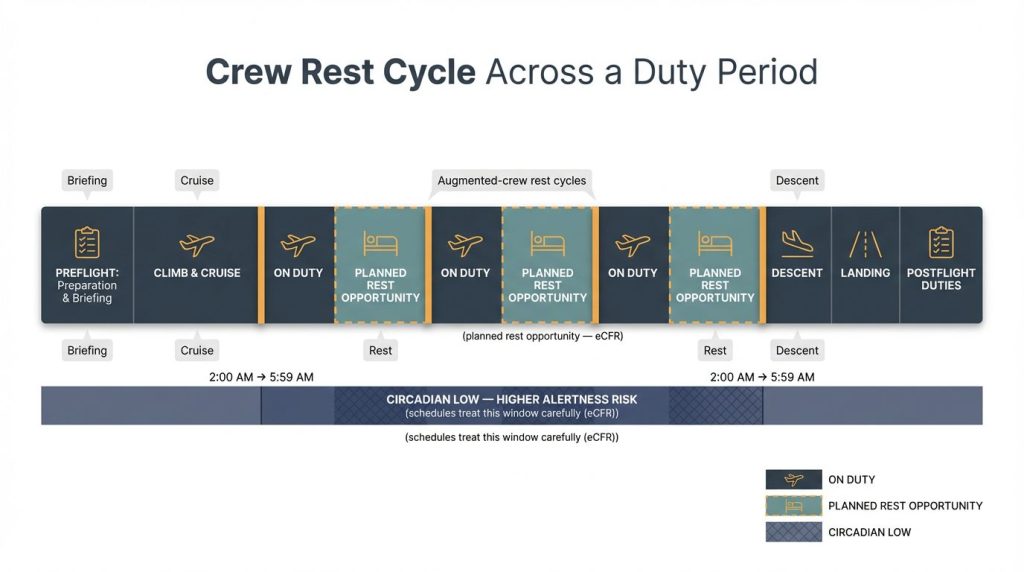
Visual Aid: Crew Rest Cycle Infographic
Imagine a simple horizontal timeline showing a duty period as a long bar.
The first segment shows preflight preparation and briefing, followed by climb and cruise.
Midway through, the bar splits into alternating blocks labeled “on duty” and “planned rest opportunity” for augmented crews. (eCFR)
Near the end, the timeline returns to “on duty” blocks for descent, landing, and postflight duties.
Underneath, a shaded band highlights the circadian low window between about 2:00 AM and 5:59 AM as a time where alertness risk is highest, which is why schedules and rest planning treat it carefully. (eCFR)
This infographic is meant to show structure and planning, not to overwhelm you with technical detail.
Fatigue Has A System
Modern airline rules describe fatigue and mitigation as operational safety, not personal grit. (eCFR)
Rest Is Defined
The regulations define duty, rest periods, and rest facility concepts for planned sleep opportunity. (eCFR)
Overnight Has Guardrails
The circadian low window is acknowledged explicitly, which is the opposite of ignoring night risk. (eCFR)
Aircraft Operations At Night And Why “Dark” Is Not “Blind”
Night flying feels different because you personally see less outside the window.
The aircraft, however, is not relying on your eyes, and the system is not relying on visual guesswork.
Airliners operate with instrument procedures, layered navigation systems, and air traffic control guidance.
Airports that support airline operations are designed with lighting systems and published procedures for night operations.
Runway and approach lighting is not decorative, and it is designed to support precision and situational clarity in low visibility. (FAA)
The FAA’s Aeronautical Information Manual includes detailed descriptions of runway lighting systems like runway centerline lighting and touchdown zone lights on precision approach runways. (FAA)
That means night operations are designed around standardized visual cues when the aircraft is close to the runway environment. (FAA)
There are also operational restrictions tied to lighting availability in certain contexts, which reinforces that night operations have “must-have” requirements rather than casual assumptions. (FAA)
Another fear point is weather at night.
For airline operations, weather evaluation is not “peek outside and hope,” and it is built into dispatch planning, onboard radar use, and instrument procedures.
That does not mean weather is irrelevant at night.
It means the system is designed to manage weather with tools and procedures that do not depend on daytime visibility.
If you are traveling with children, your biggest practical night-flight concern is usually not “is the plane safe.”
It is “how will we feel if we arrive tired, and what happens if something delays us.”
That is where planning reduces anxiety more than over-reading safety statistics.
If a delay or misconnection would create expensive domino effects, travel insurance options through VisitorsCoverage, World Nomads, EKTA, or Insubuy can help you choose protection that matches your situation, depending on the plan terms you pick.
If you encounter a disruption where compensation rules apply, services like Compensair or AirHelp can help you handle the steps without turning your arrival day into a paperwork marathon.
Night Operations Are Designed
Runway and approach lighting systems exist specifically to support safe operations in low-light conditions. (FAA)
Instruments Carry The Load
Airline navigation and approach procedures do not depend on daylight to function as intended.
Planning Reduces Worry
When disruption risk is covered and your “what if” plan is set, your nervous system settles faster.
Myths Versus Facts That Keep Nervous Flyers Stuck
Most fear around red-eyes is powered by myths that sound logical in your head at midnight.
The best way to lower that fear is to replace vague beliefs with specific truths.
This section is written for first-time travelers and parents who want straight answers.
It is not meant to dismiss your feelings.
It is meant to give your feelings better information to work with.
When you understand the system, the night feels less mysterious.
Myth: Pilots Are More Likely To Make Mistakes At Night
Fatigue risk is real in humans, which is exactly why fatigue rules and reporting frameworks exist. (eCFR)
Airlines do not treat overnight flying as normal daytime performance with different lighting.
They manage duty limits, rest requirements, and structured mitigation, including FRMS concepts in the regulatory framework. (eCFR)
Your job as a traveler is not to “evaluate the pilot.”
Your job is to pick reputable carriers, keep your personal routine steady, and remove avoidable stressors.
A simple travel routine and a low-stress first morning often does more for your experience than reading accident anecdotes.
Fact: Fatigue Is A Known Risk With Rules
The FAA defines fatigue, defines the circadian low window, and requires operational mechanisms around reporting and fitness for duty. (eCFR)
That is what it looks like when a safety system acknowledges human limits. (eCFR)
It is not a guarantee of comfort, but it is a meaningful safety feature.
It also explains why crews may appear serious and procedural on red-eyes.
That structure is a feature, not a red flag.
Myth: Night Flying Means Fewer Visual Safety Tools
Airports and procedures for airline operations are built with night operations in mind. (FAA)
Runway centerline lighting and touchdown zone lighting are examples of standardized systems that support landing and rollout under low visibility conditions. (FAA)
Airline flight operations rely heavily on instrument procedures that are designed to be consistent across conditions.
Your view out the window is not the core safety instrument.
Your view is a passenger experience feature, not the primary operating reference.
Fact: Standardized Lighting And Procedures Exist
The FAA documents runway lighting systems and their patterns because night operations are meant to be consistent and interpretable. (FAA)
Consistency is a safety multiplier, especially when visibility changes.
That is why runway systems are engineered and standardized rather than improvised.
It is also why airline operations are not equivalent to casual night driving.
The environment is controlled, monitored, and procedural.
Myth: Red-Eyes Are Riskier Because Fewer People Are Watching
Air traffic control coverage and airline operational control do not “clock out” because it is late.
Dispatch, maintenance support, and monitoring systems are built for round-the-clock operations.
The “quiet” you feel at night is a passenger perception, not a lack of oversight.
If anything, some night flights feel smoother because airports can be less congested.
That can reduce the stress of long taxi lines and crowded gate areas for families.
It is not a guarantee, but it is a common experience.
Fact: Oversight Does Not Sleep
The regulatory framework, operational control, and standardized procedures are not time-of-day optional. (eCFR)
What changes at night is your body clock, not the existence of safety systems.
That distinction is the foundation of reassurance.
If you prepare for sleep disruption, you manage the part that actually affects you.
That makes the trip feel more controlled.
Myth: Kids Should Avoid Red-Eyes Because It Is “Too Hard On Them”
Some kids do fine overnight, and some do not.
What makes it hard is not danger.
What makes it hard is sleep disruption, unfamiliar routines, and overstimulation.
Parents can reduce the impact by treating the red-eye like a bedtime routine, not like “extra screen time because it is late.”
Dim screens, keep snacks familiar, and build comfort layers like a hoodie, socks, and a small blanket.
That approach supports rest and reduces next-day crankiness.
Fact: The Challenge Is Comfort And Routine
For families, the main risk is a rough arrival morning, not a safety gap.
If your next day matters, plan it with buffer.
If a disruption would wreck a prepaid hotel or tour schedule, choose protection that matches your risk tolerance through VisitorsCoverage, World Nomads, EKTA, or Insubuy, depending on the coverage details you select.
If your flight disruption becomes a compensation scenario, Compensair or AirHelp can help you pursue it without learning the process from scratch while exhausted.
That is a practical way to protect your energy and your budget at the same time.
Myths Feed Anxiety
Replacing vague beliefs with specific truths is one of the fastest ways to reduce fear.
Families Need Structure
For parents, the best red-eye strategy is a familiar routine and a gentle first morning.
Protection Preserves Energy
When your disruption plan is set, you stop spending mental fuel on worst-case loops.
How to Feel Secure and Prepared for Your Red-Eye Flight
Red-eyes are safe to fly in the sense that airline operations are designed to function safely day or night.
What changes overnight is how you feel, not whether the rules exist.
If you focus on sleep disruption, hydration, and a low-stress arrival plan, you solve the real problem.
If you also reduce financial uncertainty with the right kind of trip protection and support tools, you remove a major source of anxiety.
Confidence grows when the system feels understandable and your personal plan feels sturdy.
That is how you turn a red-eye from a fear trigger into a simple transportation choice.
FAQ – Why Are Red-Eye Flights Still Safe After Dark — And What Actually Changes Overnight?
Are Red-Eye Flights Less Safe Than Daytime Flights?
Nighttime does not remove the core safety requirements governing airline operations.
Aircraft certification, maintenance, crew qualifications, dispatch procedures, air traffic control, and operating rules continue whether the flight departs during daylight or overnight.
Fatigue becomes a more important human-factor concern during overnight hours, which is why flightcrew duty and rest requirements specifically address it.
For most passengers, the most noticeable difference is therefore how the overnight schedule affects sleep and comfort rather than the disappearance of aviation safeguards.How Do Airlines Manage Pilot Fatigue on Overnight Flights?
Fatigue is treated as an operational safety issue rather than something pilots are simply expected to tolerate.
For covered U.S. passenger operations, FAA rules establish limits for flight time and duty periods, minimum rest requirements, and responsibilities related to being fit for duty.
Circadian timing is also recognized because human alertness naturally drops during overnight hours.
Those protections are intended to reduce fatigue-related risk before and during flight operations.What Is the Window of Circadian Low for Pilots?
The FAA regulatory framework identifies a window of circadian low associated with the body’s physiological nighttime.
For many people, the lowest-alertness period occurs during the early morning hours when the body would normally expect sustained sleep.
That is one reason an overnight duty period is not treated exactly like the same number of working hours during the afternoon.
Scheduling and rest rules account for when duty occurs as well as how long it lasts.How Do Augmented Crews Work on Long Overnight Flights?
Some longer flights carry additional qualified pilots so crewmembers can rotate between active duty and planned rest.
Approved rest facilities can range from dedicated sleeping areas to other specified rest configurations depending on the aircraft and operation.
The pilots resting during cruise are not the pilots actively controlling the aircraft at that moment.
Augmentation allows the operating crew to manage a duty period that would be much harder to perform safely without structured rest opportunities.How Can Pilots Land Safely When It Is Completely Dark Outside?
Airline pilots do not depend on daylight to know where the aircraft is or how to conduct an approach.
Flight instruments, navigation systems, published procedures, air traffic control, and airport lighting provide information throughout the arrival.
Runway centerline lights, touchdown-zone lights, approach lighting, and other systems create standardized visual references as the aircraft gets closer to the runway.
Darkness changes what passengers see outside, but it does not remove the systems used to navigate and land the aircraft.Does Air Traffic Control Work Differently Because a Flight Is Overnight?
The need for air traffic control separation and operational coordination does not disappear at night.
Controllers continue managing aircraft movements, while airline dispatch and operational support continue monitoring flights as required.
Traffic volume may change depending on the airport and hour, but quieter terminals should not be mistaken for an absence of oversight.
The airport may feel very different to a passenger at 2:00 AM even though essential operational systems are still functioning.Are Red-Eye Flights Harder for Children?
They can be harder from a sleep and routine standpoint, but that is different from saying the flight itself becomes unsafe for children.
Some children sleep surprisingly well overnight, while others become overstimulated, uncomfortable, or overtired.
Familiar pajamas or layers, a small blanket when permitted, familiar snacks, reduced screen stimulation, and a recognizable bedtime routine can make the cabin feel less disruptive.
A lighter first morning also gives families room to recover when nobody slept as well as expected.What Should Nervous Flyers Remember About Nighttime Turbulence and Weather?
Weather does not become inherently more dangerous simply because it is dark.
Flight crews and dispatchers use forecasts, onboard weather information, radar, air traffic control coordination, routing, and operational procedures rather than depending solely on visual observations outside.
Conditions such as thunderstorms or strong winds can still cause rerouting, delays, or cancellations when necessary.
A dark window can make weather feel more mysterious to a passenger even though the flight crew has information that you cannot see from your seat.How Should You Prepare for a Red-Eye If You Are Worried About Arriving Exhausted?
Protect your sleep opportunity before worrying about squeezing more entertainment into the flight.
Dress comfortably, keep an eye mask and earplugs accessible, reduce bright screens when you intend to sleep, and avoid packing essential comfort items where you cannot reach them.
Give the arrival schedule some breathing room instead of assuming you will function exactly as you would after a full night’s sleep.
That becomes especially important before long drives, important meetings, demanding tours, or tight onward connections.What Is the Most Important Thing to Understand About Red-Eye Safety?
Separate nighttime discomfort from airline operational safety.
Your body may be tired, the cabin may be dark, and the airport may feel unusually quiet, but those experiences do not mean the flight is operating without daytime safeguards.
Fatigue is a real overnight concern, which is precisely why duty limits, required rest, crew augmentation where applicable, fit-for-duty expectations, and fatigue-management systems exist.
Once you understand that distinction, the more useful question becomes how to protect your sleep, comfort, and arrival plans rather than whether darkness itself makes the airplane unsafe.