
Make the Most of Your Trip
Compare the top tours, passes, and experiences — find what fits your travel style.
Short Excerpt
- Red-eye jet lag combines two separate problems: circadian misalignment from crossing time zones and sleep loss from trying to rest overnight in an airplane cabin.
- Eastbound travel often feels harder because your body must shift sleep earlier, while westbound travel usually requires the easier adjustment of staying awake and sleeping later.
- Light exposure, sleep timing, naps, caffeine, meals, and your first night at the destination can either help your internal clock adjust or keep it anchored to home time.
Quick Take
- Treat jet lag as a timing problem rather than simply exhaustion because sleeping longer does not automatically reset your circadian clock.
- Eastbound travel generally requires shifting your body clock earlier, while westbound travel requires moving it later.
- Light is one of your strongest circadian signals, but the ideal timing depends on travel direction, number of time zones crossed, and your normal sleep schedule.
- Protect sleep on the red-eye when it overlaps with destination nighttime, then avoid letting a long arrival-day nap destroy your ability to sleep at local bedtime.
- Use caffeine strategically for alertness and stop early enough that it does not interfere with the destination sleep schedule you are trying to establish.
- A lighter first day, destination-time meals, appropriately timed daylight, and a full first night can make recovery easier than arriving with an overloaded itinerary.
Why Red-Eye Jet Lag Can Hit Harder — And How To Reset Your Body Clock Faster
A red-eye can leave you feeling much worse than an ordinary bad night’s sleep because two different problems can hit at once.
You may land with several hours of sleep debt while your internal body clock is still operating on the time zone you just left.
That distinction explains why sleeping on the plane does not automatically prevent jet lag.
Cabin sleep may reduce exhaustion, but your circadian rhythm still has to shift until your preferred sleep, wake, meal, and alertness times better match the destination.
Direction matters.
Flying east generally requires a phase advance, meaning your body needs to become sleepy and wake earlier than it normally would.
Flying west usually requires a phase delay, asking you to stay awake and sleep later, which many people find easier because the human circadian system tends to adjust more readily in that direction.
The red-eye itself can either help or complicate that adjustment.
An overnight flight that gives you some sleep during what corresponds reasonably well with destination nighttime can move you in the right direction, while fragmented sleep followed by poorly timed light and a long daytime nap can leave your body receiving conflicting signals.
Light is especially powerful because it helps tell your brain what time of day it should be.
Morning light generally shifts the body clock earlier, while late-afternoon or evening light tends to move it later, but the ideal timing becomes more complicated when you cross many time zones.
That means “get morning sun after every eastbound flight” is too simplistic for every itinerary.
The direction of travel, number of zones crossed, arrival time, and your existing circadian timing can change when bright light should be sought or avoided, making a personalized jet-lag calculator useful for larger time shifts.
Your first destination night is another major opportunity.
If exhaustion leads to several hours of afternoon sleep, you may wake just as local bedtime approaches and reinforce the very schedule you are trying to leave behind.
A short nap can be useful when you are struggling to function safely, but keep it short enough that you can still build sufficient sleep pressure for the night ahead.
Then use local meal times, appropriately timed daylight, movement, and bedtime to keep reinforcing the destination schedule.
Caffeine can help you remain alert during the adjustment, but timing matters more than simply consuming more.
Use it earlier in your destination day when needed and stop well before your intended bedtime so today’s solution does not become tonight’s sleep problem.
The fastest recovery plan is therefore not one dramatic trick. It is a series of consistent timing signals—light, sleep, meals, movement, and carefully placed caffeine—that tell your body which clock it should begin following.
Timing Is The Steering Wheel For Jet Lag
Jet lag is a circadian timing mismatch between your internal clock and the local time at your destination.
Your body wants consistency, and it uses light and routine to set that consistency.
A phase shift is the movement of your internal sleep-wake timing earlier or later to match a new time zone.
When you travel, your goal is to shift your phase in the direction that matches the destination.
Red-eyes influence that shift because they change when you sleep, when you see light, and when you eat.
That is why the same red-eye can feel helpful for one trip and brutal for another.
Eastbound Versus Westbound Jet Lag
Eastbound travel usually requires advancing your body clock, which means falling asleep earlier and waking earlier than your normal pattern.
Many travelers find this harder because your body tends to resist earlier bedtime shifts.
Westbound travel usually requires delaying your body clock, which means staying awake later and waking later.
Many travelers find westbound adjustment easier because it matches how most people naturally drift on weekends.
This is the simplest way to understand why flying east often feels like “worse jet lag.”
Red-eyes can either assist the advance or make it harder depending on how you handle light exposure and sleep timing.
Sleep Debt Makes Jet Lag Louder
Sleep debt is the cumulative deficit created when you do not get enough restorative sleep over multiple nights.
A red-eye often adds to sleep debt because cabin sleep is fragmented and short.
When you arrive already sleep deprived, jet lag symptoms feel more intense because your body is fighting two battles.
It is trying to adjust to a new clock while also trying to catch up on basic recovery.
This is why some travelers feel jet lagged even after a short time-zone shift.
The symptoms are amplified by fatigue, not only by the clock change.
Why Light Is The Real Lever
Light is the most powerful cue your body uses to shift its circadian rhythm.
Morning light tends to move your clock earlier, while evening light tends to move your clock later.
A red-eye arrival often places you directly into morning light at the destination.
That can be a gift if you need an eastbound advance, because morning light supports that direction.
It can also be a problem if you arrive at a time that gives you the wrong type of light exposure for your needed shift.
So the jet lag outcome often depends less on the flight itself and more on what you do with light after landing.
Jet Lag Follows Timing
Phase shifts respond to light, sleep, and routines, which you can influence.
Direction Changes Difficulty
Eastbound adjustment usually feels tougher than westbound adjustment for many travelers.
Sleep Debt Amplifies Symptoms
A red-eye can make jet lag feel worse if it leaves you depleted on arrival.
Why Red-Eyes Can Help Or Hurt Jet Lag
A red-eye can help jet lag when it places sleep and light exposure in the right alignment for your destination.
It can hurt jet lag when it creates fragmented sleep, wrong-time light, and a long stretch of wakefulness.
The difference comes down to the direction you fly and the arrival time you choose.
It also depends on whether you treat the red-eye as a controlled sleep attempt or an unstructured overnight.
If you leave the cabin lights and your screen bright, you delay sleep and suppress melatonin signaling.
If you reduce light and protect rest, you land with a better baseline for adaptation.
Eastbound Red-Eyes As A Jet Lag Tool
Eastbound red-eyes can be helpful because they push you toward sleeping earlier relative to the destination.
They also often land in the morning, which exposes you to destination morning light.
That morning light can accelerate the phase advance you need.
The risk is that eastbound red-eyes often produce too little sleep, creating sleep debt that makes you feel wrecked.
So an eastbound red-eye is best when you prioritize rest and build a gentle first day.
If you land and force intense meetings immediately, you often pay with a crash and worse sleep that night.
Westbound Red-Eyes And Misalignment Risk
Westbound red-eyes are trickier because they can land at odd local times.
If you arrive when your body thinks it is late night, you may feel wired or nauseated.
If you nap too long at the wrong time, you can delay adaptation and shift bedtime later.
Westbound travel often benefits from staying awake longer into the destination evening, then sleeping a full night.
A red-eye that fragments sleep can interfere with that clean reset.
So westbound red-eyes help when they support a stable bedtime, not when they create a confusing half-night.
Connections Can Multiply Symptoms
Connections can make jet lag feel worse because they extend total time awake and increase stress.
They also expose you to more artificial light at unusual hours, especially in bright terminals.
If your connection is tight, adrenaline increases, which can delay sleep even when you finally sit down.
When possible, a simpler route often reduces jet lag symptoms more than travelers expect.
This is why itinerary design is a jet lag strategy, not only a comfort preference.
Planning the least chaotic route is often the fastest route to feeling human again.
Eastbound Can Benefit
Morning arrivals and earlier sleep timing can help advance your body clock.
Westbound Needs Clarity
Westbound adjustment often improves with a stable destination bedtime, not fragmented naps.
Complexity Adds Load
Connections and stress multiply sleep loss and light exposure, which can intensify jet lag.
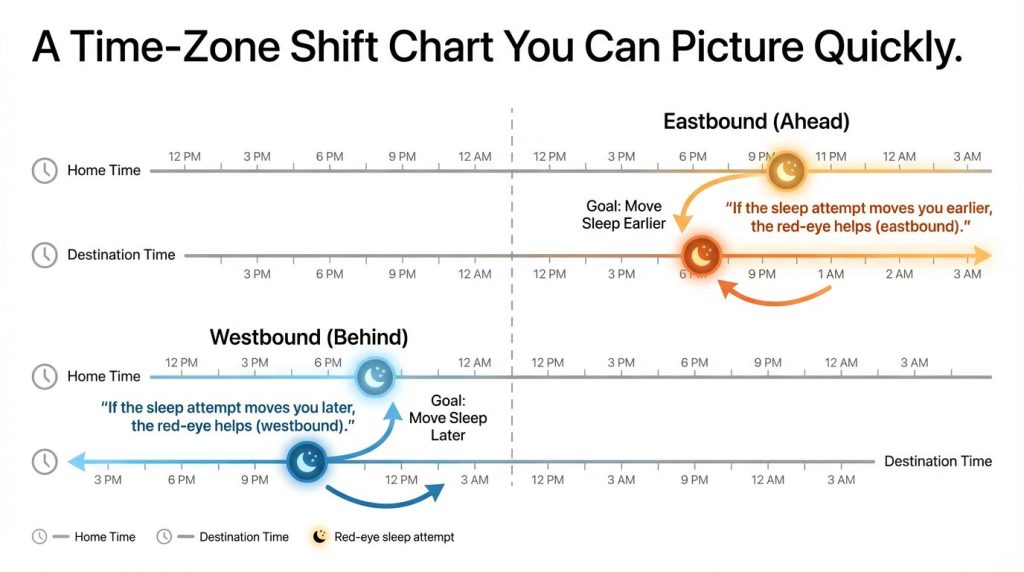
A Time-Zone Shift Chart You Can Picture Quickly
Jet lag strategy becomes easier when you visualize your clock shifting.
Imagine a simple chart with your home time on one line and destination time on another line.
For an eastbound trip, the destination line is ahead, and your goal is to move your sleep earlier.
For a westbound trip, the destination line is behind, and your goal is to move your sleep later.
A red-eye changes where your sleep attempt lands on that chart.
If the sleep attempt matches the direction you need, the red-eye helps.
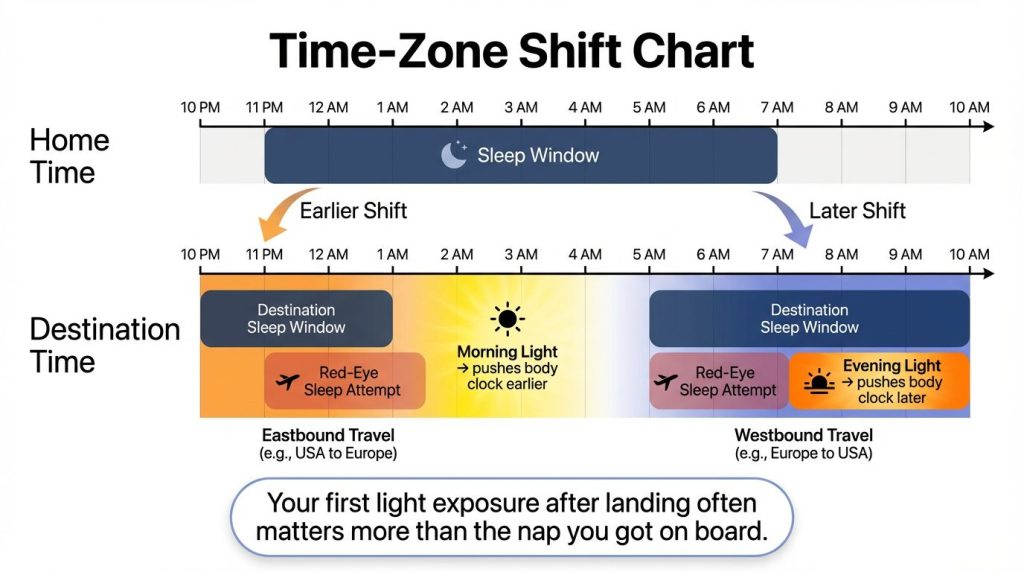
Visual Aid: Time-Zone Shift Chart
Home time sleep window is shown as a shaded block from about 11:00 PM to 7:00 AM.
Destination time sleep window shifts earlier for eastbound travel and later for westbound travel.
The red-eye sleep attempt is a second shaded block that may overlap the destination sleep window or miss it.
Morning light exposure is shown as a bright band that pushes the body clock earlier.
Evening light exposure is shown as a bright band that pushes the body clock later.
This chart makes one thing obvious, which is that your first light exposure after landing often matters more than the nap you got on board.
Action Steps That Speed Jet Lag Recovery
Your Clock Moves With Light
Light exposure is the strongest driver of phase shift, especially in the first day.
Overlap Is The Goal
The red-eye helps when your rest overlaps the destination’s night window.
First Morning Matters
What you do in the first daylight hours can speed adaptation dramatically.
Strategies That Reduce Jet Lag Symptoms After A Red-Eye
Jet lag strategy is not about forcing your body to obey.
It is about giving it clear cues and reducing conflicting signals.
The most effective cues are light timing, sleep timing, meal timing, and movement.
A red-eye complicates those cues, so you want a simple plan you can execute while tired.
When your plan is too complex, you abandon it and default to random naps and bright screens.
Simple wins because tired brains follow simple rules.
Use Light Intentionally
If you are traveling east and arriving in the morning, seek morning light at the destination.
That can mean a short outdoor walk or sitting near natural light during breakfast.
Avoid bright light late in the destination evening during the first one or two nights.
If you are traveling west, limit early morning bright light if it makes you wake too early.
Aim for light exposure later in the day to support a delayed shift.
This is a practical way to guide your phase shift without complicated tracking.
Protect A Full Night On Night One
The first destination night is the anchor that stabilizes your clock.
If you arrive after a red-eye, you may want to nap, but long naps can steal your night sleep.
A controlled nap can help, but control is the key.
If you nap, keep it short enough that you can still sleep at local bedtime.
If you are a frequent flyer, consider making the first day lighter so you can reach bedtime without collapsing at midafternoon.
Your goal is a full night, because full nights repair sleep debt and reduce symptoms quickly.
Reduce Melatonin Suppression
Melatonin suppression simply means bright light can reduce melatonin release at night.
On travel days, screens are the most common source of unnecessary light exposure.
Dim your phone, use night mode, and reduce scrolling close to your intended sleep window.
If you need to work, switch to lower brightness and stop earlier than you think you need to.
This supports your body’s nighttime signal and makes sleep onset smoother.
It is not perfection, but it is a meaningful advantage.
Manage Hydration And Meals
Hydration affects fatigue and headache risk, which can make jet lag feel worse.
Drink consistently earlier, then taper slightly as you approach sleep.
Choose lighter meals and avoid heavy late-night eating when possible.
Meal timing is also a circadian cue, and consistent meals at the destination help your clock adjust.
This is especially helpful for business travelers who need to function quickly in meetings.
Small choices here often produce a bigger impact than people expect.
Build A Low-Stress Itinerary
Stress makes jet lag worse by increasing arousal and disrupting sleep onset.
If you book a red-eye plus a tight connection plus a packed first morning, you create the perfect conditions for poor recovery.
A better approach is to build buffer and flexibility into day one.
If a delay would wreck your schedule, travel insurance through VisitorsCoverage, World Nomads, EKTA, or Insubuy can reduce financial exposure depending on the plan you select.
If a disruption becomes a compensation situation, AirHelp and Compensair can help you handle claims without turning your first day into paperwork chaos.
The point is not to expect the worst, but to remove uncertainty so your brain can settle.
Light Is Your Phase Tool
Time your daylight exposure based on eastbound or westbound needs to guide adaptation.
Night One Anchors You
Protecting the first destination night is the fastest way to reduce symptoms.
Simple Plans Work
A low-stress first day and clear routines reduce conflicting signals and speed recovery.
How to Regain Control and Adapt Quickly After a Red-Eye
Red-eyes affect jet lag because they shape sleep debt, light exposure, and timing cues all at once.
They can help when they align with the destination night window and deliver you into useful morning light.
They can hurt when they fragment sleep and push light exposure in the wrong direction.
You regain control by treating light as your steering wheel and the first destination night as your anchor.
With a practical plan, jet lag becomes predictable instead of mysterious.
That predictability is what lets international travel feel powerful instead of draining.
FAQ – Why Does Red-Eye Jet Lag Feel So Rough — And What Actually Speeds Recovery?
Why Can a Red-Eye Make Jet Lag Feel Worse Than a Normal Flight?
A red-eye can combine circadian misalignment with significant sleep loss.
Crossing time zones moves the destination clock before your internal rhythm has had time to catch up, while overnight cabin sleep is often shorter and more fragmented than a normal night in bed.
That means you can arrive both sleep-deprived and biologically out of sync.
Improving one problem helps, but completely eliminating fatigue does not automatically reset the other.Why Is Eastbound Jet Lag Usually Harder Than Westbound Jet Lag?
Eastbound travel usually requires moving your body clock earlier.
You need to become sleepy earlier and wake earlier than your internal rhythm currently expects, which is known as a phase advance.
Westbound travel generally asks your clock to shift later, and most people adapt somewhat more readily in that direction.
The difference is not universal for every traveler, but it explains why an eastbound red-eye can feel especially punishing.Can An Eastbound Red-Eye Actually Help You Adjust Faster?
It can when the timing works in your favor.
Sleeping during the flight may overlap with part of the destination’s nighttime, and arrival can place you closer to the daylight and activity period you need to adopt.
The problem appears when cabin sleep is extremely limited or your post-arrival light exposure and naps push your clock in the wrong direction.
An eastbound red-eye works best when the flight, arrival routine, and first night’s sleep reinforce the same schedule.Why Is Light So Important for Recovering from Jet Lag?
Light is one of the strongest signals regulating your circadian clock.
Exposure after your biological low point generally helps shift your rhythm earlier, while later-day or evening light tends to shift it later.
That makes light timing useful for advancing your clock after eastward travel or delaying it after westward travel.
For larger time-zone jumps, the ideal timing can become counterintuitive, so personalized guidance is more reliable than following one fixed morning-light rule.Does Sleeping on The Red-Eye Prevent Jet Lag?
No, although getting meaningful sleep can reduce the sleep-deprivation side of the problem.
Jet lag comes from your internal clock being out of alignment with local time, so even a surprisingly good night aboard the aircraft does not instantly reset your circadian rhythm.
Try to sleep when the flight timing reasonably overlaps with destination nighttime.
Once you land, daylight, meal timing, activity, and the first destination bedtime help continue the adjustment.Should You Nap After Landing from a Red-Eye?
Sometimes, but keep the nap from replacing the night’s sleep you actually need.
A brief nap can improve alertness when you arrive severely sleep-deprived and need to function safely.
Sleeping for several hours during the afternoon can reduce sleep pressure and make local bedtime much harder.
If you nap, think of it as enough rest to reach the evening rather than an opportunity to catch up on an entire missed night.How Should You Use Caffeine When Recovering from a Red-Eye?
Use caffeine to support the destination schedule rather than simply fighting fatigue whenever it appears.
It can improve alertness during the local daytime when you are trying to remain awake until an appropriate bedtime.
Stop several hours before you intend to sleep because caffeine can remain active long enough to interfere with the first night.
Late caffeine can create a frustrating cycle where you defeat daytime sleepiness only to become too alert when you finally want to sleep.Does Melatonin Help with Red-Eye Jet Lag?
It can help some travelers when the timing is appropriate.
Melatonin is a timing signal as well as a sleep-related hormone, which means taking it at the wrong time may not support the circadian shift you are trying to make.
Product dose and purity can also vary because over-the-counter melatonin supplements are not regulated like prescription medicines in the United States.
Travelers taking medications, managing health conditions, or unsure about timing should discuss its use with a healthcare professional.Why Can a Connection Make Red-Eye Jet Lag Feel Worse?
Connections can extend the amount of time you remain awake while adding stress, movement, and bright terminal lighting at biologically unusual hours.
A tight connection can also make it difficult to sleep during either flight because you remain alert about the next gate or possible delay.
Each additional segment introduces another opportunity for fragmented rest and inconsistent timing.
When schedules and prices are reasonable, a simpler overnight itinerary can make the recovery process easier.What Should You Do During the First Day After a Red-Eye?
Start reinforcing the destination’s schedule as soon as practical.
Use appropriately timed daylight, eat around local meal times, move gently after prolonged sitting, stay reasonably hydrated, and keep any necessary nap short enough to preserve nighttime sleep.
Avoid building your most demanding meetings, tours, or reservations into the first few hours after arrival when you already know the flight will leave you depleted.
The goal of day one is to give your body clear signals about when to be awake and when to sleep so the new time zone starts becoming normal.